




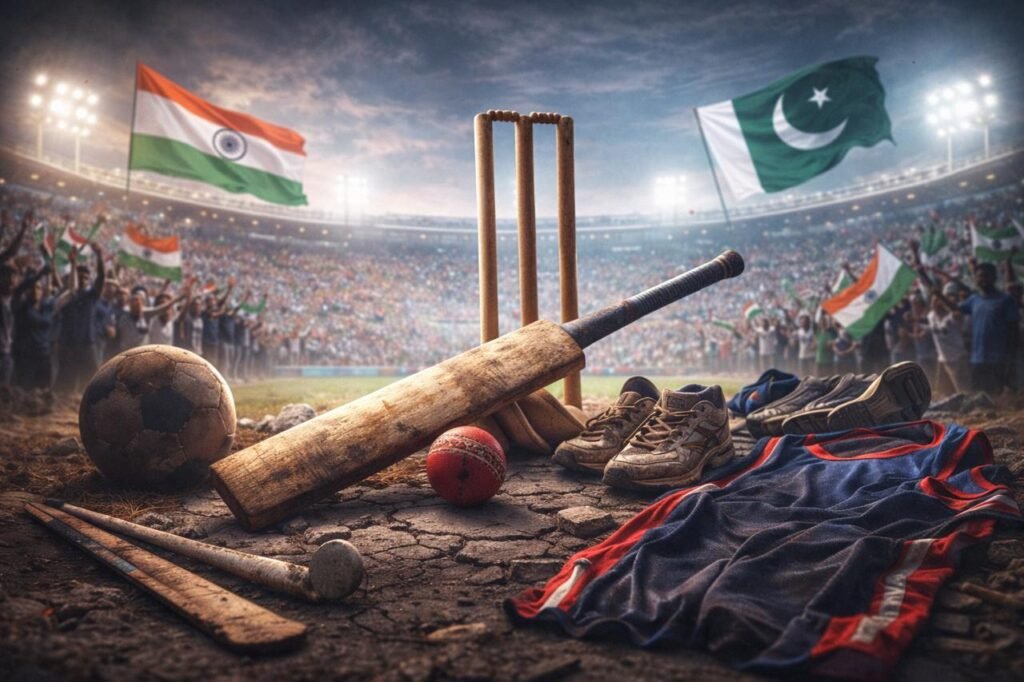
In most countries, sport is entertainment. In India and Pakistan, cricket is emotion, politics, commerce and identity woven into one spectacle. The hype surrounding cricket is not accidental rather it is the product of history, rivalry and economics converging over decades. What begins as a game often ends as a national mood.
The India–Pakistan encounter, in particular, rarely remains a sporting contest. It becomes a surrogate battlefield — a symbolic extension of unresolved histories and political narratives. Victories are celebrated like diplomatic triumphs; defeats are mourned like collective setbacks. In this sense, cricket acts less as recreation and more as a psychological outlet, a controlled arena where passions that cannot be expressed elsewhere find expression through bat and ball.
Commerce has amplified this phenomenon. Massive television rights, sponsorship deals and advertising revenues ensure that cricket is not merely popular — it is profitable. Profit, in turn, guarantees visibility. Visibility ensures dominance. This cycle feeds itself: the more cricket earns, the more it is promoted; the more it is promoted, the more it overshadows other sports. What emerges is not just popularity but monopoly of attention.
There is also a historical layer that cannot be ignored. Cricket arrived with colonial rule but stayed as a badge of post-colonial confidence. Former colonies mastered the game of their rulers and transformed it into a symbol of self-assertion. Over time, it became embedded in cultural memory. In India, it has evolved further into a tool of national projection and, at times, hyper-nationalistic spectacle. In Pakistan, it often fills the vacuum left by inconsistent state support for other sports. Where infrastructure, planning and funding faltered for hockey, athletics or wrestling, cricket found corporate backing and survived.
Media plays the role of both amplifier and architect. Continuous coverage, celebrity culture and endless debates create an ecosystem where cricket is not just followed — it is lived. Other sports struggle not necessarily because they lack talent, but because they lack narrative space. When airtime becomes currency, cricket owns the bank.
Yet this dominance is a double-edged sword. Cricket unites, but it also narrows the sporting imagination. It produces heroes, but sometimes at the cost of diversity in athletic culture. The irony is that both nations possess rich sporting histories beyond cricket — Olympic medals, world hockey titles, wrestling traditions — yet these stories fade behind the glare of a single sport.
Cricket’s overwhelming hype, therefore, is not merely about love for a game. It is about identity seeking expression, politics seeking symbolism and commerce seeking audiences. The challenge for India and Pakistan is not to diminish cricket’s passion but to broaden the spectrum of pride. A nation’s strength in sport should be measured not by one dominant arena, but by the richness of many.