




By Moanir Abi Hadi
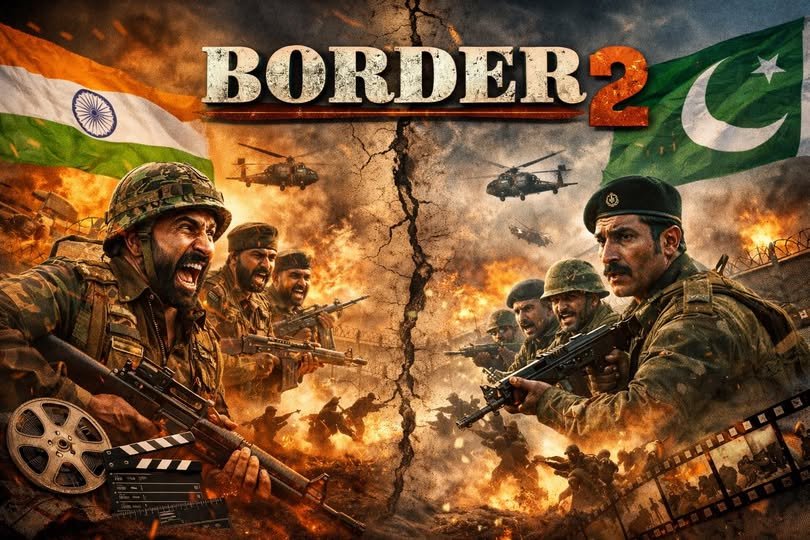
India and Pakistan are two countries that share almost everything like language, music, food, humour, clothing styles and centuries of common history. Families on both sides watch the same dramas, listen to the same songs and even use similar phrases in daily life. Yet, in recent years, many big-budget films especially war-centric productions like Border 2 is presenting the neighbours not as the people with shared culture but as a permanent enemy. This trend deserves deeper reflection not emotional reaction.
Cinema is often called entertainment but it is also a powerful tool. What people repeatedly watch slowly shapes what they believe. When films continuously show one country only as a threat, a villain or a target to be defeated, they influence public psychology especially young audiences who may not know real history or real people across the border. Over time, fiction begins to replace facts and dramatic exaggeration becomes perceived truth.
The problem is not patriotism. Every country has the right to celebrate its heroes and history. The concern arises when patriotism turns into commercial hostility. Conflict-based movies are financially safe projects because they guarantee ticket sales, television rights and online views. Producers know that emotions sell faster than balanced storytelling. As a result, complex political realities are simplified into “good versus evil” narratives which may entertain for three hours but leave long-term emotional consequences.
Artists are not soldiers and cinema is not a battlefield. Their role is different. When creative industries repeatedly fuel anger or fear, they indirectly harden public attitudes making real diplomatic dialogue more difficult. Public opinion once emotionally charged, becomes less open to compromise, cooperation or even cultural exchange. This is where art quietly shifts from expression to influence.
The irony is striking: two societies that understand each other’s languages without subtitles are slowly being taught to misunderstand each other emotionally. Instead of showing shared festivals, music collaborations or human stories, screens are increasingly filled with explosions, slogans and simplified enemies. Such portrayals may strengthen temporary nationalism but weaken long-term regional stability.
Cinema has the ability to reduce distance or increase it. It can remind people that borders are political realities but human connections are cultural realities. Balanced storytelling does not mean ignoring conflicts but it means presenting them with context, depth and humanity rather than one-sided spectacle. In regions where neighbours cannot be changed, narratives matter even more.
In the end, movies do more than entertain because they build perceptions. If screens repeatedly show hostility, minds begin to expect it. If they show understanding, societies slowly learn it. The real question is not whether films should be patriotic but whether they should also be responsible.