




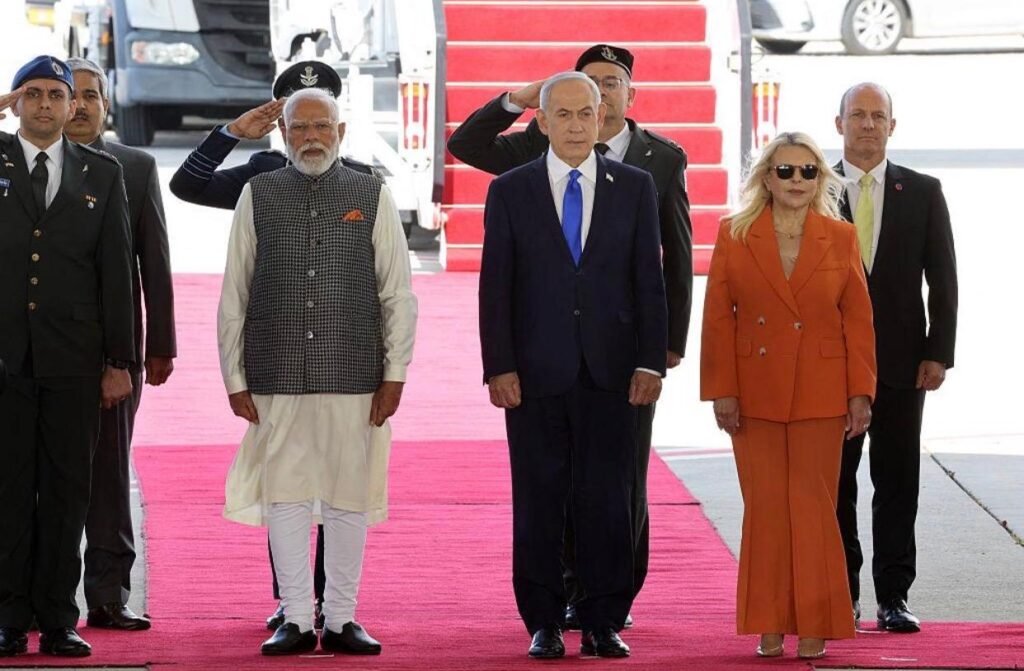
The February 2026 visit of Indian Prime Minister Narendra Modi to Israel marked more than a ceremonial engagement. Hosted by Israeli Prime Minister Benjamin Netanyahu, the visit underscored the accelerating strategic convergence between New Delhi and Tel Aviv. For Pakistan, this growing alignment does not constitute an immediate crisis but signals a structural shift in the regional security environment that warrants careful reassessment and calibrated policy response.
Since Modi’s landmark 2017 visit, India–Israel ties have expanded from conventional defence procurement into a broad strategic partnership encompassing defence production, intelligence coordination, artificial intelligence, cybersecurity and emerging technologies. India has become Israel’s largest defence customer and discussions reportedly include cooperation on advanced missile defence systems and high-energy laser capabilities. The relationship is no longer limited to buyer and seller dynamics but increasingly reflects joint development and potential technology transfer. For Pakistan, the concern lies not merely in additional military hardware but in the qualitative advantage India may derive through integrated air defence systems, network-centric warfare capabilities and real-time intelligence cooperation. The operational implications of this partnership were visible during the 2025 India–Pakistan aerial confrontation when Indian forces reportedly deployed Israeli-origin platforms, reinforcing the perception that defence collaboration now has direct battlefield relevance.
At the geopolitical level, the Netanyahu’s proposal of a “hexagon of alliances” positioning India alongside Greece, Cyprus and other partners indicates Israel’s intention to institutionalise new regional alignments. Although the framework remains loosely defined yet it appears aimed at counter balancing both Iran-aligned actors and what Israeli leadership describes as emerging Sunni strategic configurations. Pakistan is unlikely to be explicitly identified as a target within this formulation. However, its expanding security cooperation with Saudi Arabia and its close defence relationship with Turkiye may indirectly situate it within evolving regional threat narratives shaped by Indian and Israeli strategic perceptions. The broader implication for Islamabad lies in the consolidation of shared security assessments between New Delhi and Tel Aviv that may increasingly intersect with Western policy frameworks.
Simultaneously, Gulf dynamics add further complexity to Pakistan’s strategic calculus. Islamabad’s 2025 Strategic Mutual Defence Agreement with Riyadh signalled a strengthening of bilateral security ties that are yet regional alignments remain fluid as Gulf states continue to diversify partnerships including expanded strategic engagement with India. For Pakistan, the Gulf remains economically indispensable through remittances financial support and energy cooperation. This reality underscores the importance of complementing security partnerships with deeper economic integration across Central Asia ,Türkiye, Iran and broader Eurasian connectivity corridors. Geo-economic resilience will be as critical as military preparedness in sustaining strategic autonomy.
Intelligence cooperation between India’s Research and Analysis Wing and Israel’s Mossad has historical depth and its intensification in areas such as counterterrorism ,cybersecurity and surveillance could amplify India’s diplomatic narrative portraying Pakistan as a destabilising actor. Strategic competition therefore extends beyond military capability into perception management and international influence. Pakistan will need to invest in diplomatic outreach, strategic communication and demonstrable counterterrorism performance to prevent adverse framing in multilateral forums.
Despite these evolving pressures, Pakistan retains significant leverage. Its nuclear deterrence framework continues to provide strategic stability in South Asia while its geographic position linking South Asia Central ,Asia China and the Middle East ensure enduring geopolitical relevance. Diversified defence partnerships and incremental modernisation efforts reduce vulnerability to any single alignment. Moreover, Pakistan’s ability to maintain working relations with major powers including China ,the United States ,Saudi Arabia and Turkiye offers diplomatic flexibility in a fragmented regional order.
The India–Israel partnership reflects a broader transformation in regional geopolitics driven by technological integration, security cooperation and converging threat perceptions. For Pakistan the challenge is not imminent encirclement but long-term strategic adaptation. Managing this transition will require calibrated deterrence, economic strengthening ,diversified diplomacy and sustained engagement in regional deescalation efforts. In a rapidly evolving security landscape, Pakistan’s strategic position remains consequential yet its effectiveness will depend on prudent statecraft rather than reactive alignment politics.
Saira Iftikhar


