



As rising temperatures accelerate glacier melt across Pakistan, communities in the country’s high-altitude Himalayan region are reviving a centuries-old Indigenous practice known as glacier grafting to counter growing water scarcity. Home to nearly 13,000 glaciers and ranked among the world’s most climate-vulnerable nations despite contributing less than one percent of global emissions, Pakistan faces warming trends that are occurring nearly twice as fast as the global average. In these fragile mountain ecosystems, shrinking glaciers threaten irrigation, livestock and daily survival.
Glacier grafting that is locally called “glacier marriage” involves planting ice at carefully selected high-altitude sites to create artificial glaciers. The tradition dates back to at least the 14th century and evolved over time into a community-led method of managing water shortages. Across the border in Ladakh, a related innovation known as the ice stupa preserves frozen water in conical shapes that melt gradually and extend water availability into spring.
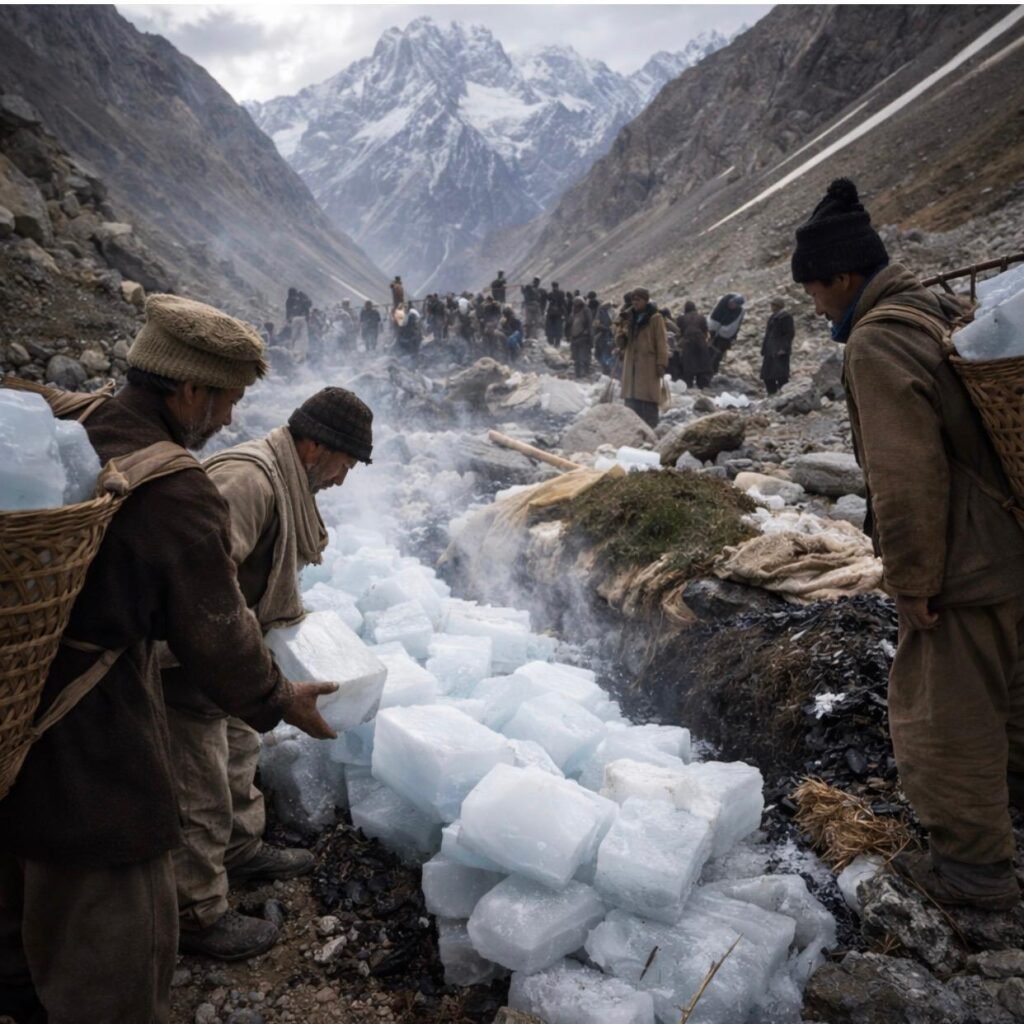
The grafting process begins with volunteers collecting around 200 kilograms of “male” and “female” ice from separate valleys. Male ice is darker while female ice is lighter and believed to produce more fertile melt water. Historically, villagers carried the ice for days across steep slippery terrain in wooden cages strapped to their backs. The materials required include coal, grass, salt and water drawn from seven different streams. Before setting out, participants recite Quranic verses, perform rituals and pray. Strict environmental and cultural discipline is observed that includes no plastics, no harm to living beings, no immoral conduct and only locally produced food consumed. Ice must never touch the ground and remains in constant motion until planted.
At a north-facing, wind-exposed site protected from avalanches and direct sunlight, a trench is dug. Male ice is placed on the right and female ice on the left, layered with salt, coal and grass. Water from the seven streams is slowly dripped over the structure to bind it together. Over months, the mass fuses and with seasonal snowfall it strengthens. If it survives at least three years of snow cycles, it expands gradually and over time can become a reliable water source often within two decades.
The practice is deeply spiritual. Silence is maintained and even vehicles transporting ice are not switched off. If a volunteer tires, the basket is passed without resting it on the ground. Traditionally, the process concludes with Gang Lho songs sung directly to the glacier, addressing it as a living being whose survival ensures the community’s own.
Glacier grafting is not guaranteed to succeed. It depends on snowfall, stable temperatures and peaceful conditions. Climate extremes and military activity in glacier regions can disrupt its survival. While it cannot fully offset large-scale glacier loss, it remains a powerful example of community-driven climate adaptation in the face of intensifying water scarcity. Yet as younger generations move toward urban livelihoods, the inter-generational transfer of this Indigenous knowledge is weakening even as its relevance grows stronger in a warming world.