




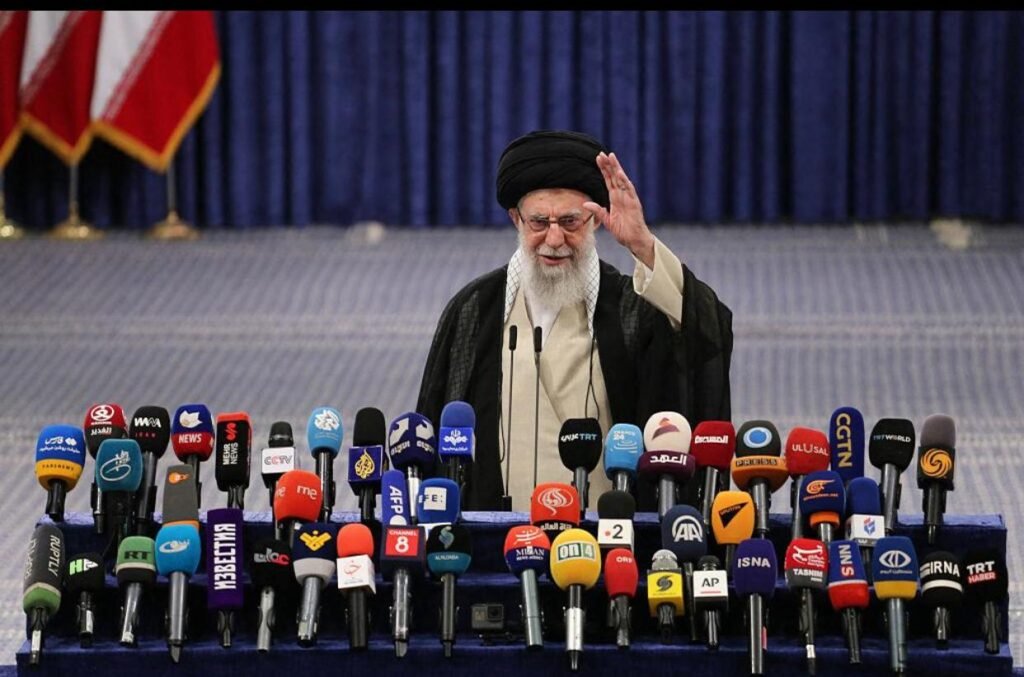
The Middle East has entered one of its most volatile geopolitical moments since the Iraq War. The coordinated United States–Israel military operation that killed Iran’s Supreme Leader Ayatollah Ali Khamenei has not merely removed a political figure but it has also shattered an entire strategic equilibrium that governed regional power for more than three decades. What is unfolding now is not a single conflict but a cascading crisis — military, ideological, economic and civilizational.
This editorial examines the conflict analytically, separating immediate military outcomes from long-term geopolitical consequences while critically assessing the pros and cons arising from Khamenei’s death.
A Decapitation Strike That Redefined the Conflict
In late February 2026, U.S. and Israeli forces launched a highly coordinated campaign targeting Iranian leadership, missile infrastructure and nuclear-linked facilities. Intelligence-driven strikes reportedly killed dozens of senior commanders alongside Khamenei in what analysts describe as a “decapitation strategy” aimed at weakening Iran’s governing structure. 
Iran responded with missile attacks on U.S. bases and Israeli targets across the Gulf region while allied groups such as Hezbollah opened new fronts, expanding the conflict beyond Iran’s borders. 
Rather than ending confrontation, the assassination transformed a shadow war into an openly regional one.
Immediate Political Shock: Power Vacuum or System Resilience?
Contrary to expectations of regime collapse, intelligence assessments suggest Iran’s political system remains institutionally resilient. An interim leadership council has assumed authority under constitutional provisions and security forces remain cohesive — a critical factor preventing immediate regime breakdown. 
This reveals a key analytical insight:
The Islamic Republic was never a one-man system; it is a layered ideological state supported by military, clerical and bureaucratic networks.
Thus, leadership removal does not automatically equal regime change.
The Pros: Arguments Advanced by Supporters of the Strike
Supporters of the operation — primarily in Israel, parts of the West and segments of the Iranian diaspora — frame Khamenei’s death as strategically beneficial.
1. Disruption of Iran’s Strategic Command
Eliminating the supreme leader and senior commanders temporarily disrupts centralized decision-making, slowing coordinated military responses.
2. Potential Reset of Nuclear Negotiations
Some policymakers believe new leadership could adopt a more pragmatic posture toward nuclear diplomacy opening space for renegotiation.
3. Symbolic Blow to Revolutionary Ideology
Khamenei represented continuity of the 1979 Islamic Revolution. His removal weakens ideological legitimacy particularly among younger Iranians already disillusioned by economic hardship.
4. Encouragement to Domestic Opposition
Celebrations among parts of the diaspora and anti-regime activists reflect hopes for political liberalization after decades of authoritarian governance. 
The Cons: Strategic and Moral Risks
Yet history suggests assassinations of ideological leaders often produce unintended consequences.
1. Martyrdom Effect
Inside Iran and across Shia communities, Khamenei’s death has triggered mourning, protests and mobilization. Iran declared a national mourning period, reinforcing religious symbolism rather than weakening it. 
Martyrdom may strengthen ideological cohesion rather than dissolve it.
2. Hardliner Consolidation
Power vacuums in revolutionary systems rarely produce moderates. Analysts warn successors may emerge from the Islamic Revolutionary Guard Corps (IRGC) potentially more militant than Khamenei himself. 
3. Regional Escalation
The conflict has already expanded:
•Hezbollah missile attacks from Lebanon
•Gulf-region retaliation
•Threats to global oil routes through the Strait of Hormuz 
This increases the probability of a multi-front Middle East war.
4. Global Economic Shock
Disruption in the Strait of Hormuz — through which a large share of global oil flows — risks energy price spikes and worldwide inflationary pressure.
5. International Law and Precedent
The assassination of a sitting head of state raises profound legal and ethical questions. Critics argue it normalizes targeted killing as a tool of regime change potentially destabilizing global norms governing sovereignty.
*Ripple Effects Beyond the Middle East
The consequences are already global:
•Protests and counter-protests erupted worldwide. 
•Violent demonstrations occurred in Pakistan including an attack on the U.S. Consulate in Karachi resulting in casualties. 
•Governments and international bodies have urged immediate de-escalation amid fears of wider war. 
The conflict has become not only geopolitical but civilizational — polarizing public opinion across religious, ideological and national lines.
Analytical Verdict: Tactical Victory, Strategic Uncertainty
The killing of Ayatollah Khamenei represents a tactical success but a strategic gamble.
History offers sobering parallels: removing leaders rarely eliminates the structures that produced them. Instead, it often radicalizes successors, deepens grievances and prolongs conflict cycles.
Three scenarios now compete:
1.Controlled Transition — Iran stabilizes internally and negotiates internationally.
2.Hardline Entrenchment — IRGC dominance intensifies confrontation.
3.Regional War Spiral — proxy conflicts merge into a broader Middle East war.
At present, evidence points toward the second scenario.
Conclusion
Khamenei’s death closes one chapter of Middle Eastern history but opens a far more unpredictable one. For Israel and the United States, the operation may have removed a long-standing adversary. For Iran, it risks transforming political authority into sacred memory. For the world, it raises a deeper question:
Can assassination reshape ideology — or does it merely give it a new life?
The answer will define the next decade of global geopolitics.