




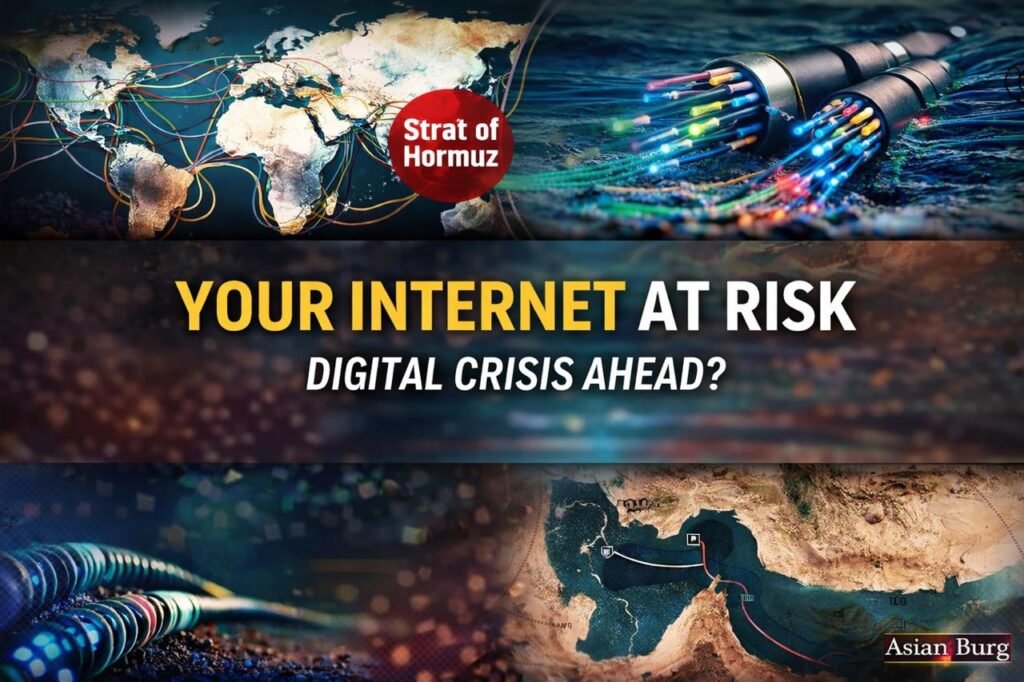
The Strait of Hormuz is widely known as one of the most critical oil transit routes in the world, a narrow passage through which a significant portion of global energy supply flows. Yet, in today’s interconnected world, its importance extends far beyond oil and gas. Beneath the surface of these waters lies an invisible but essential infrastructure that powers modern life: a network of submarine fiber optic cables carrying the vast majority of the world’s digital data.0
Nearly 95 percent of global internet traffic travels through these undersea cables. They form the backbone of everything from video calls and social media to banking transactions, stock markets, cloud computing and medical data systems. Many of these cables pass through or near the Strait of Hormuz, making it not just an energy chokepoint but a crucial digital corridor linking South Asia, the Middle East and Europe.
This reality introduces a largely overlooked risk. If severe damage were to occur in or around the Strait of Hormuz, the consequences would not be limited to fuel markets or shipping routes. The disruption could extend into the digital realm affecting everyday services that billions of people rely on. Internet speeds could slow dramatically, communication platforms such as messaging and video calls could face interruptions and online banking systems and payment networks might experience delays or even temporary failures. Financial markets which depend heavily on real-time data transmission, could also be affected.
The vulnerability of these systems lies in the nature of the cables themselves. Although designed to withstand harsh underwater conditions including pressure, storms and minor seismic activity, they remain susceptible to deliberate damage or major disruptions. When a cable is compromised, it’s repairing is neither quick nor simple. Specialized ships must first locate the exact point of failure on the ocean floor, retrieve the damaged section, carry out repairs and then carefully reinstall it. This process can take weeks or even months. During this time, data is rerouted through alternative pathways, often leading to congestion and significantly reduced internet performance.
Recent incidents have already demonstrated how fragile this infrastructure can be. Disruptions in undersea cables in the Red Sea caused noticeable slowdowns and interruptions in digital services across parts of South Asia. In countries like Pakistan and India, online payment systems and banking operations were affected for extended periods, even in the absence of direct conflict. These events serve as a reminder that the global digital ecosystem depends on a relatively delicate physical network.
The Strait of Hormuz has also emerged as a key node in global connectivity offering one of the fastest digital routes between regions. Any instability in this corridor could compromise not only regional connectivity but also international data flows. In an era where economies, governments, and societies depend on uninterrupted digital access, this represents a significant strategic vulnerability.
What makes this situation particularly important is the shift in how we understand critical infrastructure. Traditionally, chokepoints like the Strait of Hormuz were viewed primarily through the lens of energy security. Today, they must also be understood in terms of data security and digital resilience. Control over physical resources is no longer the sole determinant of influence; control over data flows and communication networks has become equally significant.
The growing dependence on digital systems means that disruptions in connectivity are no longer minor inconveniences. They can affect economies, governance, healthcare and daily life at every level. A slowdown in internet speed is not just a technical issue—it can delay financial transactions, disrupt businesses and limit access to essential services.
In this context, the Strait of Hormuz represents more than a geopolitical hotspot rather it is a critical junction in the global digital network. Any serious disruption in this region would be felt not only in energy markets but also in the everyday digital experiences of millions of people.
Moanir Abi Hadi
_About the Author:_
Moanir Abi Hadi is a media analyst and content strategist at Asian Burg, producing insightful work on geopolitics, digital infrastructure and social change. He can be reached at _info@asianburg.com_