



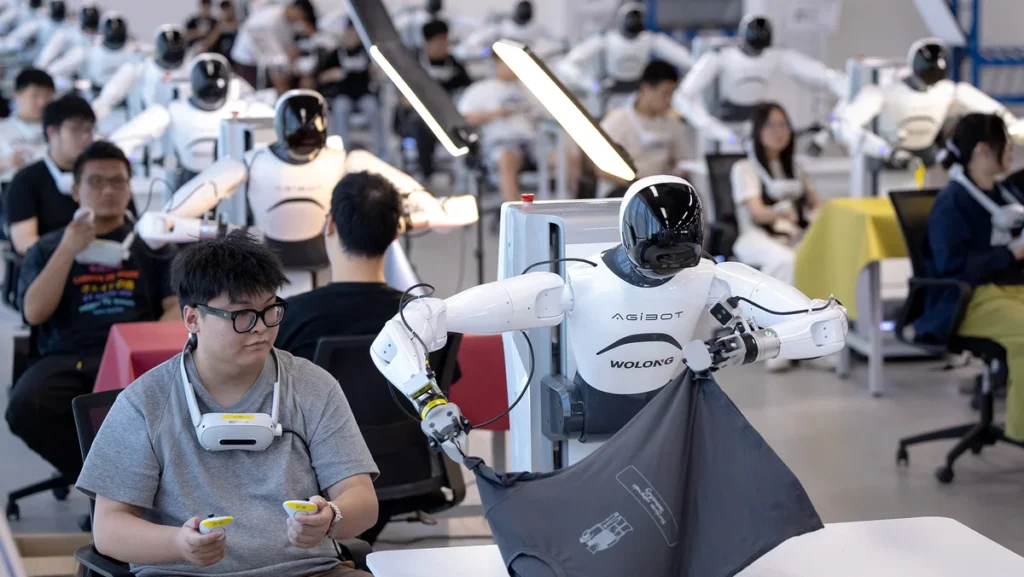
A new form of digital work is emerging globally, where people record themselves performing everyday household tasks to help train the next generation of humanoid robots. Simple activities like cooking, cleaning and organizing are now being transformed into valuable training data for artificial intelligence systems designed to operate in real world environments.
The growing push to develop general purpose robots has created a massive demand for first-person or “egocentric” data. This type of footage allows machines to learn how humans interact with objects, navigate spaces and perform tasks with precision.
Companies such as Micro1 have built large networks of contributors who film their daily routines using head mounted cameras or smartphones. With thousands of participants across dozens of countries, these firms are generating hundreds of thousands of hours of video each month. Still, experts believe this is only the beginning as training advanced robots may require billions of hours of real-world data.
The concept follows a path similar to AI systems like ChatGPT, which learned from massive volumes of text. However, teaching robots is far more complex, as it involves understanding movement, spatial awareness and physical interaction rather than just language or visuals.
To make this data usable, companies annotate videos so machines can identify objects, measure distances and replicate human actions. This process is fueling rapid growth in the data labeling industry, driven by increasing demand from robotics and artificial intelligence sectors.
Another key factor is diversity. Household environments vary widely across regions meaning robots must be trained on a broad range of scenarios. From differences in kitchen layouts to cleaning tools, global data collection helps ensure robots can adapt to different settings and cultures.
At the same time, training methods are evolving. Traditional approaches relied heavily on simulations or expensive hardware setups but human recorded data is emerging as a more practical and scalable solution. It allows developers to gather real world interactions without the need for costly robotic systems during the training phase.
Major technology companies are adopting mixed strategies. Nvidia continues to advance simulation based training, while Tesla is developing its humanoid robot using internal datasets. Research suggests that combining simulation with real human data significantly improves performance, particularly in tasks requiring precision and adaptability.
Despite these advancements, challenges remain. Robots still struggle with unpredictable environments where objects move and conditions constantly change. Experts emphasize that machines lack human like intuition the ability to instinctively understand force, balance and uncertainty.
For now, humanoid robots are primarily used in controlled environments like factories, where tasks are repetitive and predictable. Even then, their reliability is not yet at the level required for widespread commercial use.
Safety concerns also remain significant. Robots must be able to accurately distinguish between objects and living beings, especially in home settings. Until these risks are minimized, the vision of robots fully integrated into daily life remains a work in progress.
Nevertheless, this approach marks a significant step toward the future of automation. By learning directly from human behavior, robots are gradually becoming more capable of handling complex, real-world tasks bringing the idea of intelligent household assistants closer to reality.
Keywords:
humanoid robots future, AI training data human videos, robot learning chores, egocentric data AI, smart home robots future, Micro1 robotics, Nvidia AI robotics, Tesla Optimus robot training, automation daily life, future of AI robots
Asian Burg Global Desk
Send your feedback via email info@asianburg.com