



In 1948, South Africa entered one of the most defining and painful chapters in its history with the formal establishment of apartheid. This system of institutionalised racial segregation divided society into rigid categories based on race, primarily separating Black Africans, white citizens and mixed-race communities. The policy did not merely classify people, it determined their entire lived experience, from political rights to everyday mobility.
Under apartheid, Black South Africans were systematically deprived of basic rights, including the right to vote and meaningful participation in national governance. Public spaces were segregated, transportation systems were divided and economic and social opportunities were heavily skewed in favour of the white minority. While white citizens were allowed full political participation and access to national leadership, Black Africans were largely excluded from decision-making structures that governed their own country.
As global awareness of these injustices grew, international institutions and sporting bodies began to take a stand. Major organisations, including Olympic committees and football authorities, imposed boycotts and restrictions on South Africa. Sport, often seen as separate from politics, became one of the most powerful tools of international pressure against the apartheid regime.
After decades of internal resistance and global isolation, apartheid finally came to an end in the early 1990s. In 1994, South Africa held its first democratic elections and Nelson Mandela became president. His leadership marked not only a political transition but also the beginning of a broader effort to rebuild a deeply divided nation.
Mandela recognised that political reform alone would not be enough to heal the country. He viewed sport as a powerful instrument of unity and national transformation. In a society fractured by race and inequality, shared national teams and collective sporting pride could help create a sense of belonging that politics alone could not achieve.
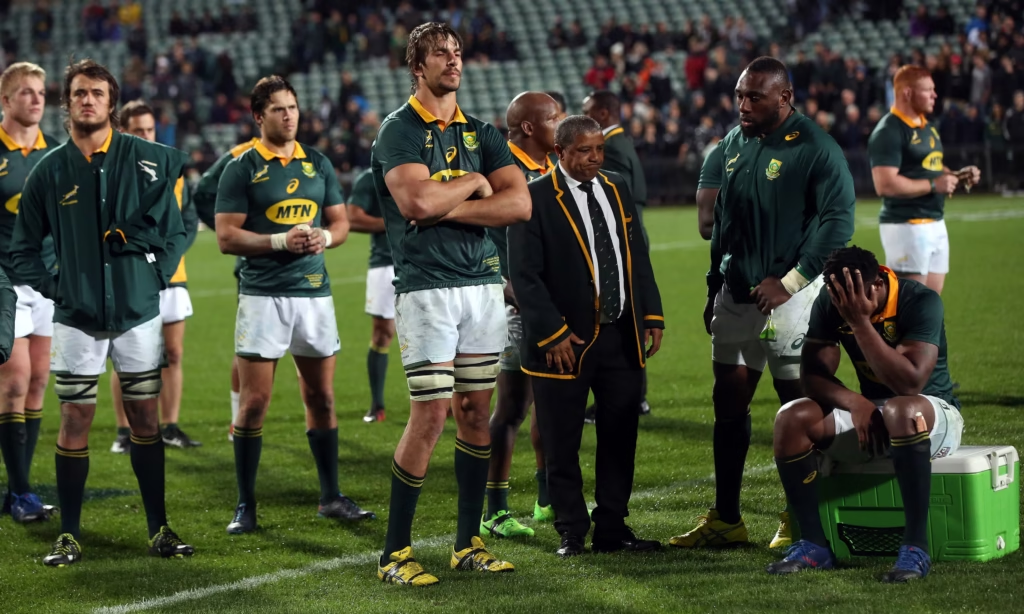
This vision began to take shape in the mid-1990s. South Africa’s success in winning the Rugby World Cup in 1995 became a symbolic moment of unity bringing together communities that had previously been divided by decades of mistrust. Soon after, football also became a key platform for national integration with efforts to build inclusive teams representing all racial groups.
The 1996 Africa Cup of Nations further reinforced this trajectory. South Africa’s national football team, selected on principles of racial inclusivity, went on to win the tournament creating one of the earliest post-apartheid moments of shared national celebration. Sport was no longer just competition; it had become a language of reconciliation.
In the years that followed, South Africa continued to participate in global tournaments, including FIFA World Cup appearances in 1998, 2002 and as host nation in 2010. While the team did not achieve deep runs in most of these tournaments, their presence on the world stage represented something larger than results. It symbolised a nation attempting to redefine itself beyond its history of segregation.
The use of sport as a nation-building tool in South Africa remains one of the most cited examples of cultural and social transformation. It demonstrates how collective identity can be rebuilt not only through laws and institutions but also through shared emotional experiences that transcend historical divisions.
Ultimately, South Africa’s journey shows that sport can function as more than entertainment. In the aftermath of deep political and racial conflict, it became a mechanism for unity, healing and the gradual construction of a new national identity.
Keywords:
apartheid South Africa history, Nelson Mandela sports unity, South Africa Rugby World Cup 1995 significance, Africa Cup of Nations 1996 South Africa, FIFA World Cup South Africa history, sports and nation building, post apartheid reconciliation South Africa, Mandela leadership sports strategy, South Africa racial segregation history, sports diplomacy examples
Asian Burg | History / Sports