



Human beings like to believe that they are the authors of their own actions.
We choose whether to be kind or cruel, patient or impulsive, generous or selfish. We praise people for making good decisions and blame them when they make destructive ones. Much of society from families and schools to courts and governments rests on the assumption that people could have acted differently.
But what if that assumption is fundamentally wrong?
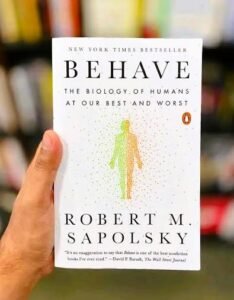
That is the uncomfortable question at the heart of biologist and neuroscientist Robert Sapolsky’s work on human behavior. His argument is not simply that biology influences what we do. It is that every action emerges from a chain of causes stretching backward through our brains, hormones, childhood experiences, genes, environment, culture and evolutionary history.
If that is true, the idea of completely independent free will becomes extremely difficult to defend.
We are shaped long before we act
Consider a moment of anger.
The action may appear instantaneous: someone says something offensive, the brain reacts and the person responds. But the reaction did not begin with those few seconds.
Hormones, neural activity, memories, learned habits and previous experiences all helped shape the response. Childhood influences affected the developing brain. Social circumstances influenced beliefs. Genetics contributed to biological tendencies. Even the environment surrounding the person at that particular moment can alter behavior.
Sapolsky’s larger point is that human behavior is rarely explained by one cause.
Testosterone, for example, does not simply create aggression. Its effects depend on circumstances and existing tendencies. Genes can influence behavior without dictating it. The brain can change through learning and experience.
This makes human beings less predictable but also more complicated than the simple division between “good people” and “bad people.”
The uncomfortable case against free will
The most controversial part of the argument comes when Sapolsky extends this reasoning to conscious choice.
If every decision has causes that existed before the decision was made, then where exactly is free will?
We may experience ourselves as choosing, but the experience of choice could itself be part of the same chain of biological and environmental events.
This is the philosophical position known as determinism.
It does not mean that people are robots in the ordinary sense. People think, deliberate, compare alternatives and change their behavior. The difficult question is whether those mental processes are themselves freely initiated or whether they too are the result of earlier causes.
That distinction matters enormously.
Responsibility becomes harder to define
If behavior is shaped by forces people did not choose, punishment becomes a complicated moral question.
A person does not choose their genes. They do not choose the family into which they are born, the conditions of their childhood or many of the experiences that shape their brain.
That does not mean society should ignore harmful behavior.
It does mean that punishment, rehabilitation and prevention may need to be considered differently.
A justice system focused entirely on blame asks: What did this person deserve?
A system influenced by determinist thinking might instead ask: What caused this behavior, how can future harm be prevented and what response is most likely to change the person?
That is not necessarily a softer approach. In some circumstances, protecting society may still require restricting someone’s freedom. But the purpose of that restriction can shift from revenge toward protection, rehabilitation and prevention.
The paradox of changing people
Here is where the argument becomes especially fascinating.
Sapolsky maintains that humans can overcome tendencies created by biology and experience. People can learn, reflect, develop empathy and alter deeply established patterns of behavior.
But if everything is determined by prior causes, then even that transformation has causes.
A person does not simply wake up and freely decide to become more compassionate. Perhaps a teacher influenced them. A book changed their thinking. A relationship altered their priorities. A painful experience forced reflection. A new environment created different habits.
In other words, the ability to change may itself be part of the causal system.
That does not make change meaningless. Quite the opposite.
It suggests that education, culture, parenting, social policy and personal relationships matter precisely because they become part of the chain that shapes future behavior.
Biology does not erase human possibility
There is a danger in taking determinism too far.
If people conclude that behavior is biologically predetermined, they could begin treating cruelty, prejudice or violence as unavoidable. That would be a serious misunderstanding.
Human behavior is extraordinarily flexible.
The same species capable of warfare is capable of cooperation on an enormous scale. People can learn prejudices but they can also unlearn them. Fear can be reinforced, but it can also be challenged. Violent environments can produce violence but different environments can produce different outcomes.
Human nature is therefore not a fixed instruction manual.
It is a complicated interaction between biology, experience and circumstance.
The real lesson may be humility
The strongest challenge posed by Sapolsky’s argument is not that free will must disappear from everyday life.
It is that we should become more humble about how much control any individual actually has over becoming the person they are.
That humility could change how we think about criminals, children, political opponents, strangers and even ourselves.
It can also coexist with accountability. Society still needs rules. Harm still needs to be prevented. Victims still matter. Dangerous behavior still has consequences.
But understanding the causes of behavior can make accountability more intelligent rather than less serious.
Perhaps the deepest lesson is this: whether or not free will exists in the philosophical sense, human beings clearly influence one another.
Every experience becomes a possible cause of something that happens later.
A teacher can change a student’s future. A parent can shape a child’s emotional world. A law can alter incentives. A conversation can redirect a life.
If our choices are part of a chain of causes, then the question is not simply whether we are free.
It is what kind of causes we want to become.
Rafia Batool
About Author:
The author writes about food safety, cultural issues and well-being focusing on raising awareness about healthy practices, cultural understanding and public health. Their work aims to educate readers and promote safer, healthier and more informed communities.
Keywords: free will, Robert Sapolsky, human behavior, determinism, neuroscience, responsibility, human nature, biology and behavior, criminal justice, philosophy of free will