



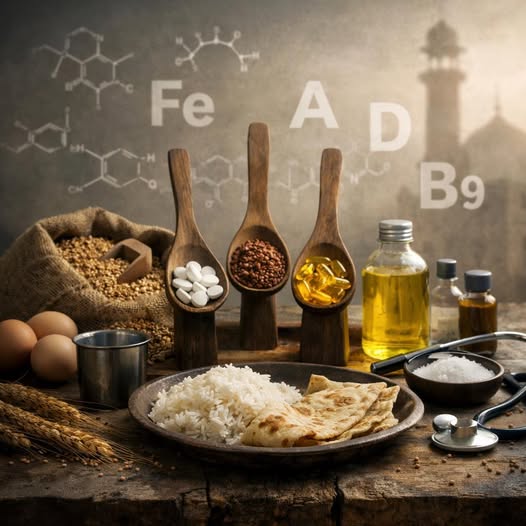
Most Pakistanis have food on their plates, yet millions remain malnourished.National surveys consistently show that around 40% of Pakistani children are stunted, over 40% of women suffer from anemia and vitamin D deficiency affects a majority of the population across age and income groups. This contradiction reveals a quiet national crisis: the absence of essential nutrients in everyday food. Deficiencies in iron, iodine, folic acid and vitamins A & D continue to damage health, immunity and development across the country. Food fortification, in this context, is not a technical luxury but one of the most practical and equitable public-health responses available.
Food fortification simply means adding essential nutrients to staple foods people already consume such as wheat flour, salt, oil and ghee. Countries that have implemented it seriously have reduced anemia, birth defects, childhood blindness and immune disorders without forcing people to change their diets or bear additional costs. Pakistan’s own nutrition indicators reinforce this logic: high anemia among women, stunting in children, and deficiencies across income groups show that food quantity alone is not enough. Food quality matters just as much.
Despite its proven value, food fortification in Pakistan has struggled due to policy inconsistency, weak regulation, limited industry compliance and low public awareness. Too often it is treated as an optional initiative rather than a core national nutrition strategy. As a result, implementation varies across regions, weakening its collective impact.
There is also a persistent misconception that micronutrient deficiency affects only the poor. In reality, urban and middle-class populations consuming highly processed diets are equally vulnerable. Modern food systems deliver calories with convenience, but not nutrition. This is precisely why food fortification works—it reaches everyone quietly, without stigma or exclusion.
For fortification to succeed, trust and governance are essential. Consumers must be confident that fortified foods are safe and scientifically regulated, while producers need clear standards, monitoring, and support. Without oversight, fortification risks becoming a label rather than a guarantee.
The question, therefore, is not whether Pakistan needs food fortification but whether it is willing to treat nutrition as a long-term national investment rather than a short-term intervention. Micronutrient deficiency may not dominate headlines, but its consequences shape the country’s future. Food fortification remains one of the quietest shields against that slow erosion—if taken seriously.
By Abi Hadi