




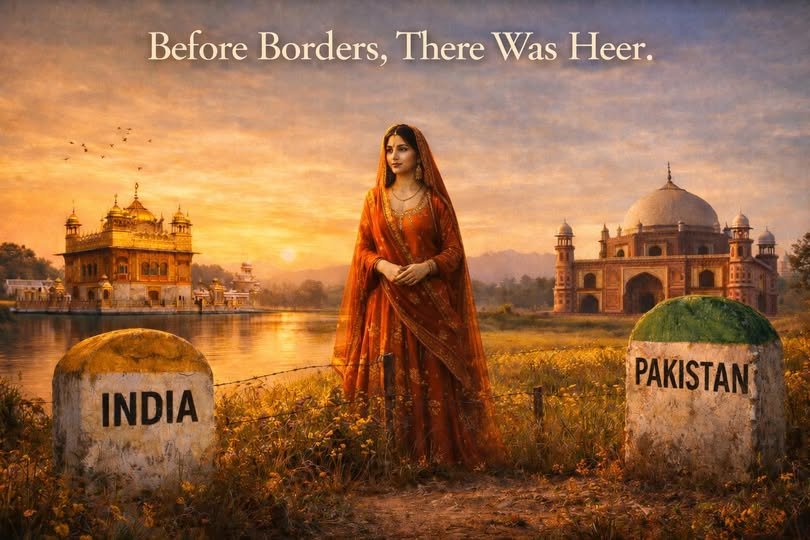
Before modern borders divided India and Pakistan, before identities were reorganised around politics and statehood, there existed a shared moral and cultural world in Punjab. Heer Ranjha, composed by Waris Shah, emerged from that world not as a religious text nor as folklore entertainment but as a civilisational document speaking to conscience, justice and human dignity.
Heer was never confined by creed. It circulated naturally among Muslims, Sikhs and Hindus because its moral language was Punjabi, not theological. It addressed universal human concerns: love constrained by power, honour enforced through cruelty, authority shielded by custom and morality emptied of compassion. In village gatherings, homes, shrines and cultural assemblies, Heer was read, sung and remembered without religious qualification. It belonged to the people of Punjab before it belonged to any community.
This shared ownership is not accidental. Waris Shah did not write to defend doctrine or affirm identity; he wrote to interrogate society. His critique of hollow religiosity, social hypocrisy and coercive authority resonates across belief systems precisely because it refuses sectarian alignment. Heer’s moral clarity challenges elders, clerics and custodians of honour alike. Ranjha’s journey exposes the emptiness of performative renunciation. These are ethical arguments not communal ones.
Partition disrupted this continuity. Political borders reordered memory and culture began to be filtered through religious identity. Texts once understood as shared heritage were gradually reassigned communal labels. Yet Heer resisted confinement. Its continued reverence among the Hindus, Sikhs, Muslims and the Punjabi diaspora on both sides of the border demonstrates the resilience of cultural memory against political rupture.
What sustains Heer across time and territory is its ethical universality. Waris Shah speaks to human dignity before doctrine, justice before obedience and conscience before authority. That is why Heer remains relevant in societies still negotiating the relationship between power and morality.
Remembering Heer as a shared inheritance is not nostalgia rather a historical accuracy. It reminds us that the deepest cultural foundations of this region were plural long before they were partitioned. Before hardened identities created by borders, there was Heer—a voice that continues to speak across lines drawn much later insisting that humanity precedes division.