


— Asian Burg
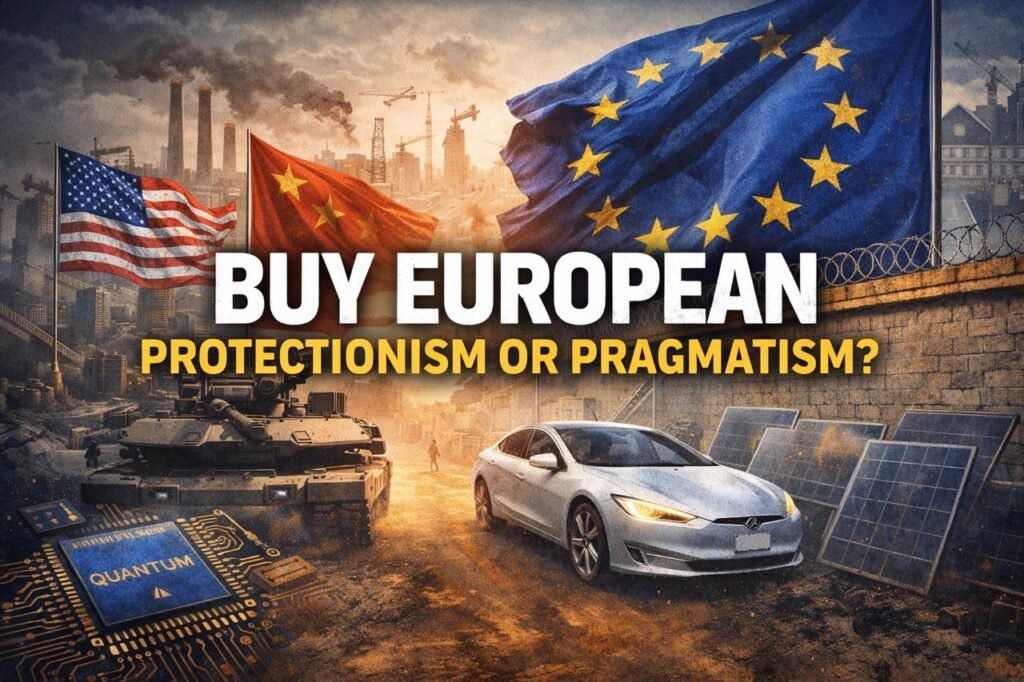
The European Union’s emerging “Buy European” policy marks more than an industrial adjustment. It signals a psychological shift in how Europe now views global trade. For decades, the EU championed open markets and multilateralism. Today, facing assertive industrial policies from the United States and China, Europe appears to be cautiously stepping into the same arena of strategic protection.
At its core, the policy is not outright isolationism. It is selective shielding. By prioritising European companies in public procurement especially in defence, clean technology, AI, quantum computing and space, the bloc is attempting to secure industries that define future power rather than merely present profit. This reflects a broader global reality: economic security has become inseparable from national security.
Yet the move carries an inherent paradox. Europe built its prosperity on openness, free movement of goods and cross-border integration. Now it must balance that legacy with the need to prevent de-industrialisation and capital flight. The compromise phrase “Made with Europe”allowing trusted partners’ content is an acknowledgement that full protectionism would contradict the EU’s own economic DNA.
Politically, the policy exposes internal fractures. France sees it as strategic defence, Germany fears excessive debt and fiscal strain while smaller export-driven states worry about retaliation. Economically, it could revitalise local manufacturing and innovation but it may also raise costs, trigger trade disputes and complicate supply chains that are already deeply globalised.
For the rest of the world—including emerging economies the lesson is clear: the age of purely free trade is fading into a phase of managed interdependence. Nations are no longer asking how to compete only on price but they are asking how to secure technology, talent and industrial sovereignty. Europe’s decision is therefore less about exclusion and more about recalibration.
Whether “Buy European” becomes a shield against decline or a wall that limits growth will depend on execution. Protection without innovation breeds complacency; protection coupled with research, skills and productivity can strengthen resilience. The EU now stands at a delicate crossroads—trying to defend its industries without losing the openness that once made them thrive.