



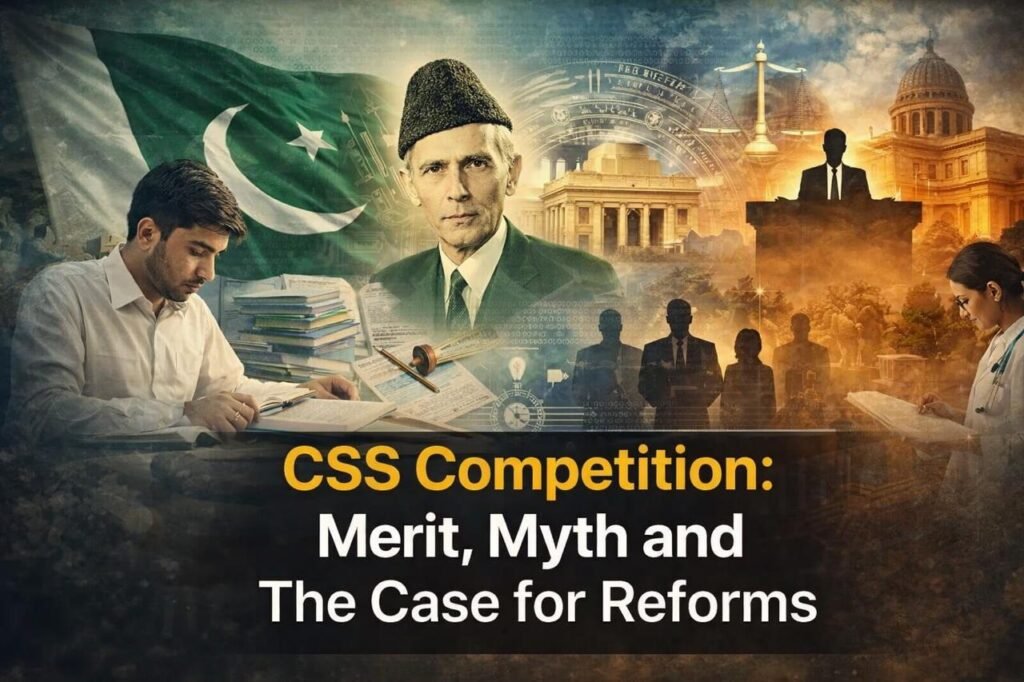
CSS Competition: Merit, Myth and the Case for Reform.The Central Superior Services (CSS) examination occupies a unique place in Pakistan’s administrative imagination. It is seen as the ultimate meritocratic gateway to power, prestige, and policy influence. For thousands of young aspirants each year, CSS represents not just a career path but a social ascent, a validation of intellect and an entry into the state’s inner machinery. Yet behind its aura of rigor and competition lies a system increasingly misaligned with the demands of modern governance.
At its core, CSS was designed to select individuals capable of administering a wide range of state functions through intellect, judgment and adaptability. This model made sense in an era when the state was smaller, governance simpler and specialization limited. Today, however, the state operates in a vastly different environment: complex economies, digital systems, climate stress, public health challenges and regulatory governance demand technical depth alongside administrative skill. The examination, unfortunately, has struggled to evolve at the same pace.
One of the most persistent criticisms of CSS is its excessive reliance on rote learning and subjective evaluation. While the syllabus appears vast and intellectually demanding, success often depends less on analytical ability and more on examination strategy, coaching culture and mastery of predictable patterns. This dynamic privileges those with access to expensive academies and insider knowledge, quietly undermining the very idea of equal opportunity that CSS claims to uphold.
The optional subject structure further distorts merit. Scoring disparities between subject often unrelated to actual administrative relevance encourage tactical selection rather than genuine intellectual interest or aptitude. Candidates are rewarded for gaming the system rather than preparing for public service. Over time, this has produced cohorts of officers who are examination-smart but unevenly equipped for specialized policy domains.
Equally problematic is the disconnect between recruitment and service needs. Officers selected through CSS are expected to manage taxation, policing, planning, diplomacy, and regulation often with minimal prior exposure to these fields. While training attempts to bridge gaps, it cannot compensate fully for structural mismatches between selection criteria and functional requirements. The result is a governance system heavily dependent on post-entry learning by trial and error.
The competition also perpetuates a narrow conception of success. The prestige hierarchy among occupational groups reinforces a culture where power and control are valued over service delivery, regulation or technical excellence. This not only distorts preferences among candidates but also entrenches generalist dominance at the expense of professional cadres, creating friction and inefficiency within the state apparatus.
Reforming CSS does not mean diluting merit; it means redefining it. A modern civil service requires diverse entry streams, not a single all-purpose examination. Lateral induction of specialists, domain-specific competitive tracks and greater weight to analytical writing, policy reasoning, and ethical judgment would better serve contemporary governance needs. Examination content must shift from memory-based recall to problem-solving grounded in Pakistan’s real administrative challenges.
Transparency and standardization in evaluation are equally critical. Subjective marking erodes trust and credibility. Technology-assisted assessment, anonymized scripts, and greater disclosure of marking criteria can reduce arbitrariness without sacrificing rigor. Coaching culture thrives in opacity and reform thrives in openness.
Finally, reform must extend beyond the exam itself. Career progression, performance evaluation and training should reward competence, integrity and results not merely seniority or group affiliation. Without post-entry reform, even the best recruitment system will eventually disappoint.
The CSS examination has produced many capable and dedicated public servants. Its problem is not intent but inertia. Institutions that refuse to evolve gradually lose relevance, even when wrapped in tradition and prestige. If Pakistan seeks a civil service fit for twenty-first-century governance, CSS must be seen not as a sacred relic but as a living system—open to scrutiny, adaptation and reform.
The real question is not whether CSS is difficult. The question is whether it is useful in selecting the kind of minds the state now needs. Until that question is answered honestly, competition will continue but reform will remain deferred.
(The writer is a civil servant and policy analyst who writes on public administration, governance reform, and institutional development.)