


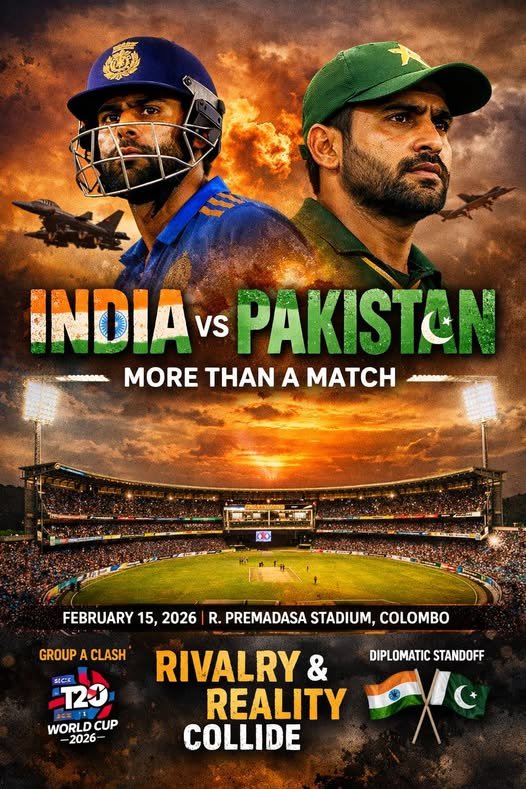
The upcoming India–Pakistan clash on 15 February 2026 is not merely a Group-A fixture of the ICC Men’s T20 World Cup rather it feels like a temporary truce between two nuclear-armed neighbours. Scheduled at Colombo’s R. Premadasa Stadium, the game arrives after weeks of diplomatic tension that almost led to a boycott turning cricket once again into a stage where politics quietly shadows sport.
*The Neutral Ground Paradox*
Although India is hosting most of the tournament but Pakistan’s refusal to travel across the border pushed the event into a hybrid format, making Colombo the symbolic capital of this rivalry. The so-called “neutral venue” reflects how cricket often tries to escape geopolitics yet never fully succeeds. Even small gestures or their absence — before the match remind fans that the contest carries baggage far beyond the scoreboard.
*Performance vs Pressure*
On paper, India enters with momentum and confidence, a side polished by recent wins and tactical depth under Suryakumar Yadav’s leadership. Pakistan, captained by Salman Ali Agha, arrives in a rebuilding phase — unpredictable, volatile but capable of surprise. Their spin-heavy bowling attack could turn Colombo’s slowing pitch into an equaliser, proving that form does not always dictate fate in this rivalry.
*Sport or Spectacle?*
For administrators, the match is a commercial goldmine; for broadcasters, it is guaranteed global attention; for fans, it is emotion distilled into a few overs. The sold-out stadium and massive digital audiences show that this contest is no longer just cricket nut it is culture, business and diplomacy rolled into one.
Yet beneath the noise lies a simple truth that this is one of the rare spaces where the two nations meet as equals, governed not by politics but by the laws of the game. For a few hours boundaries are drawn only on the field and the bat and ball speak louder than rhetoric.