


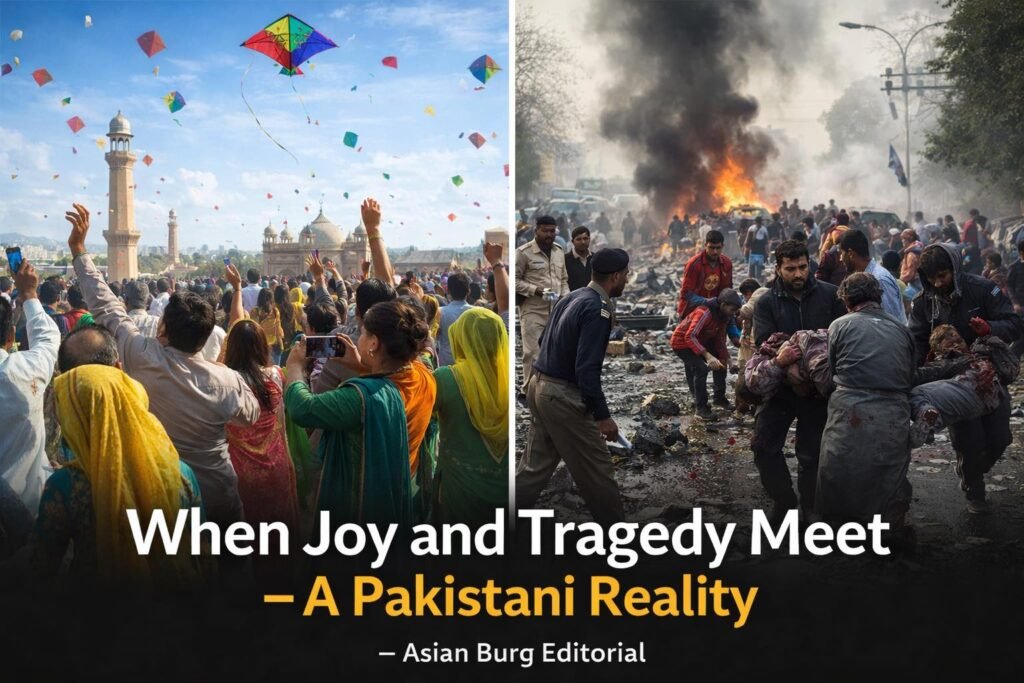
Lahore recently witnessed a scene many thought had disappeared forever. After nearly two decades, Basant returned with colour, music , dance, festivities and life. Rooftops were decorated, kites filled the sky with rainbow like colours and families came out together — children, women, elders, everyone sharing a rare public happiness. For a moment, the city felt light, got united and felt free from daily worries.
But almost at the same time, a tragic suicide blast in Islamabad took many innocent lives and injured dozens more. Within hours, the national mood shifted from celebration to sorrow. This painful contrast is not new for Pakistan. It often feels as if moments of collective joy are quickly followed by incidents that pull the nation back into grief and fear.
Many people describe this feeling with a common phrase — “our happiness gets the evil eye (Hamari Khushi ko nazar lag jati hai).” Yet beyond cultural expression, it reflects a deeper psychological reality. Years of economic instability, terrorism, security challenges and uncertainty have shaped a society that celebrates cautiously. Even during festivals, a part of the public mind remains alert, almost expecting disruption. It is not superstition rather it is collective memory.
There is also another harsh truth. Acts of violence often aim to disturb precisely those moments when a society feels united and hopeful. Joy represents normal life and normal life challenges fear. When celebrations occur, they become symbols of confidence — and unfortunately, symbols sometimes become targets. In that sense, such tragedies are not only physical attacks but emotional ones as well.
However, there is another side to this picture. Despite repeated setbacks, Pakistan continues to celebrate. The rooftops did not empty completely, the music did not entirely stop, and communities still gathered. This persistence is not ignorance of danger rather it is resilience. It shows that society refuses to surrender its right to happiness.
The real challenge for Pakistan is not only improving security but also healing its social mindset. A nation must learn to celebrate without fear and mourn without losing hope. Happiness should not feel temporary or risky but it should feel natural and deserved.
Pakistan’s story is therefore not just about joy interrupted by tragedy. It is about a society learning to hold both emotions at once — grief and celebration without letting either define its future. The return of festivals, colours and public gatherings quietly sends a message that fear may interrupt life but it cannot permanently stop it.