



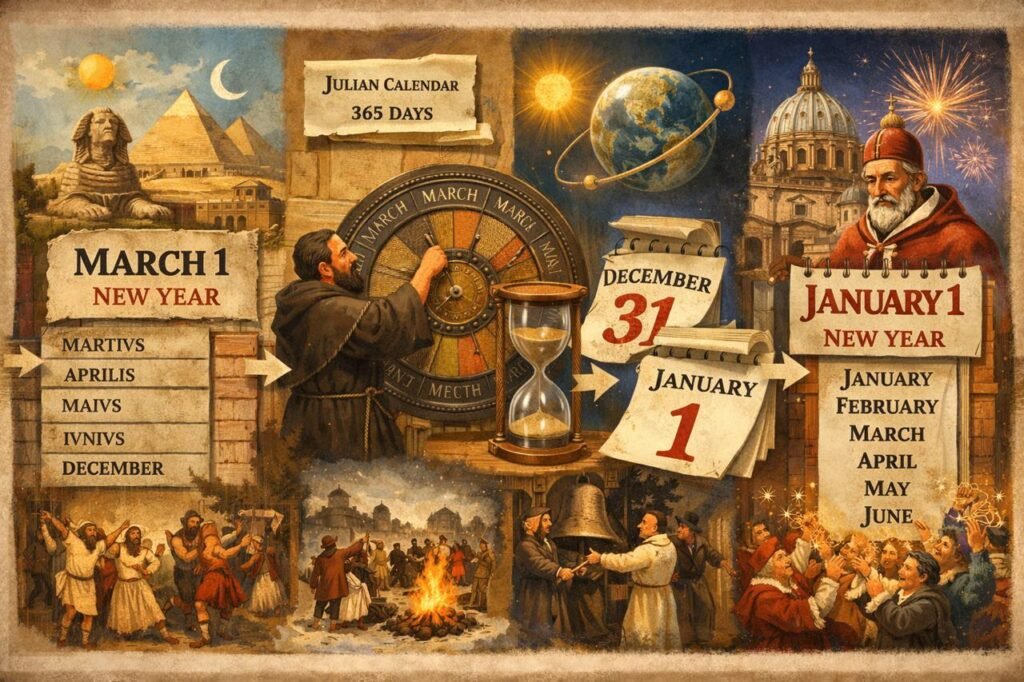
It may surprise many that January was not always the first month of the year. In ancient Rome, the calendar originally began in March, a month tied to farming, spring, and warfare—practical concerns of an agrarian society. Time, then, followed nature rather than numbers.
The shift came in 153 BCE, driven not by superstition but by governance. Roman consuls, who assumed office annually, needed to take charge earlier to manage wars and administration. January, already associated with Janus, the god of beginnings, gates, and transitions, became the logical starting point. Janus looked both backward and forward—an elegant metaphor for a new year standing between past and future.
This change was cemented by Julius Caesar’s Julian Calendar in 46 BCE, which aligned the year with the solar cycle and standardized January as month one. Later, when the Gregorian calendar reformed timekeeping in 1582, January’s primacy remained untouched.
Thus, January’s status is not religious destiny but administrative wisdom and symbolic clarity—a reminder that even our sense of time is shaped by power, practicality, and human choice.
Time, after all, does not begin—it is declared.