


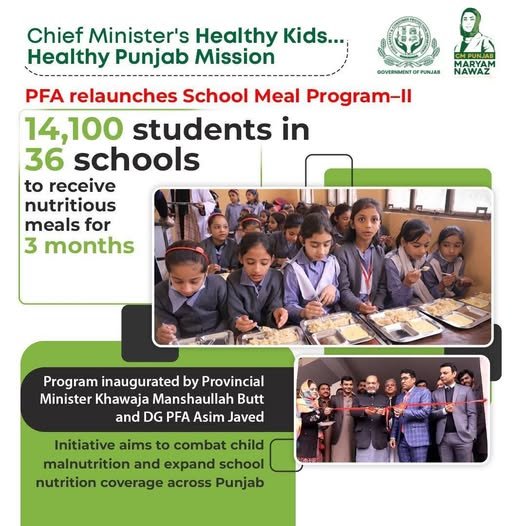
Child nutrition is not merely a welfare concern but it is also a public-health and education issue that shapes cognitive ability, immunity, school attendance and long-term productivity. Recognising this, the Punjab Food Authority has launched a structured School Nutrition Programme (SNP) under the vision and direction of the Chief Minister of Punjab, Ms. Maryam Nawaz Sharif and led by Director General Punjab Food Authority, Mr. Muhammad Asim Javed. The initiative has been devised as a comprehensive institutional intervention rather than a temporary feeding drive. Implemented in collaboration with the welfare organisation Allah Walay Trust, the pilot phase is being introduced in approximately 70 schools of Lahore, targeting around 75,000 primary-level children from underprivileged backgrounds. The programme is further strengthened through technical support from UNICEF, Global Alliance for Improved Nutrition and the Nutrition International (NI), ensuring that global best practices and scientific nutritional standards inform its design and delivery. The objective is clear: to address hidden hunger, micronutrient deficiencies and growth-related concerns at the earliest stage of schooling.
The strength of the programme lies in its operational model which is designed around measurement and accountability. Before the start of meal distribution, students undergo pre-screening to assess nutritional status, height, weight and other health indicators. This is followed by a defined intervention phase during which carefully designed cooked meals planned by professional nutritionists are served on daily basis five days a week. After the completion of the cycle, post-screening evaluations are conducted to measure improvement and generate evidence-based reports. This three-tier model transforms the initiative from a symbolic welfare act into a structured public-health experiment backed by data, institutional ownership and professional oversight.
The broader importance of this programme extends well beyond daily meals. Nutritional intervention at the primary-school level directly influences learning capacity, physical development and long-term social mobility. A well-nourished child is more attentive in classrooms, less prone to illness and more likely to complete schooling with stronger cognitive skills. By institutionalising nutrition within the education ecosystem, the Punjab Food Authority is addressing tomorrow’s economic and health burdens. If the pilot project yields encouraging and transparent results, its expansion across Punjab could mark a significant shift from reactive welfare to preventive governance where investment in a child’s plate becomes an investment in the province’s future strength.
#foodie #cmpunjabmaryamnawazsharif#nutrition
—-*Asian Burg*