



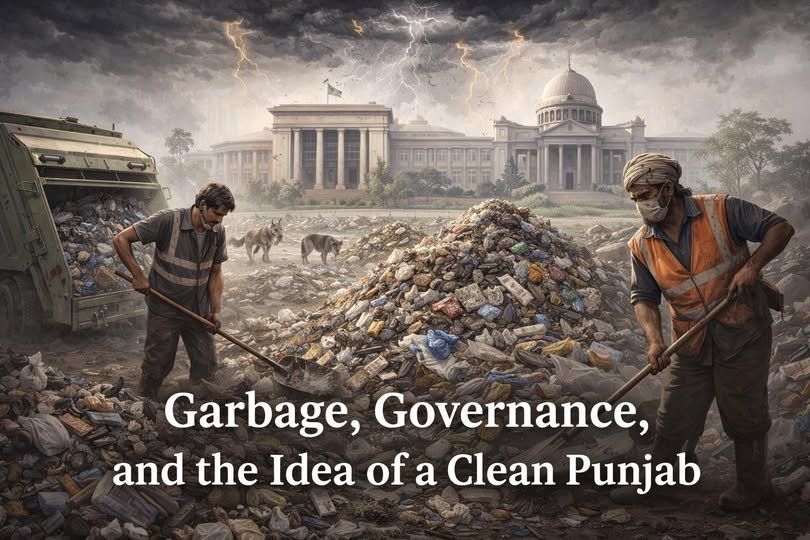
The launch of Suthra Punjab marks a significant moment in Punjab’s long and often faltering struggle with urban decay, solid-waste mismanagement and the quiet normalization of filth in public spaces. On the surface, it is a cleanliness drive; in substance, it is a test of governance capacity, institutional coordination and public ownership of civic responsibility.
Punjab’s waste problem is neither new nor mysterious. Rapid urbanization, weak municipal institutions, fragmented mandates between local governments, contractors and provincial departments and a chronic neglect of sanitation workers have produced cities where garbage is not an exception but a permanent feature of the landscape. Previous initiatives promised transformation but collapsed under politicization, short-term optics and lack of continuity. Suthra Punjab therefore enters a terrain littered not just with waste but with public skepticism.
What distinguishes Suthra Punjab at least in intent,is its attempt to frame cleanliness as a province-wide governance priority rather than a seasonal campaign. By emphasizing structured monitoring, standardized cleanliness benchmarks and district-level accountability, the initiative acknowledges a fundamental truth: sanitation failures are administrative failures. Clean cities do not emerge from slogans; they emerge from systems that collect, transport, process and regulate waste every single day without exception.
However, the success of Suthra Punjab will depend on whether it confronts three hard realities. First, cleanliness cannot be sustained without empowered and professional local governments. Municipal bodies remain financially weak, administratively dependent and politically sidelined. Unless they are given stable funding, technical capacity and autonomy, cleanliness drives will remain dependent on provincial push rather than local pull.
Second, sanitation workers,the invisible backbone of any clean city must move from exploitation to dignity. Protective equipment, fair wages, health coverage and social respect are not cosmetic concerns but they directly determine service quality and continuity. A cleanliness campaign that overlooks those who clean is morally hollow and operationally fragile.
Third, public behavior matters as much as government action. Without sustained civic education, strict enforcement of waste laws, and social penalties for littering, the state will continue to clean what citizens continue to dirty. Cleanliness is ultimately a social contract: the state provides services; the citizens respect public space.
There is also a deeper governance lesson embedded in Suthra Punjab. Cleanliness is often treated as a low-politics issue yet it is among the most visible indicators of state effectiveness. A government that cannot keep streets clean struggles to convince citizens of its competence in more complex domains like health, education or economic reform. Conversely, when public spaces are orderly, trust in institutions quietly improves.
Suthra Punjab therefore deserves cautious support not blind applause. Its promise lies not in before-and-after photographs but in whether it institutionalizes cleanliness as a permanent function of the state. If it evolves into a rules-based, data-driven and locally owned system, it can redefine urban governance in Punjab. If it succumbs to symbolism, contractor capture or political fatigue, it will join the long list of well-named but short-lived initiatives.
Cleanliness is not about aesthetics alone; it is about dignity, discipline and credibility of governance. Suthra Punjab has opened a necessary conversation. The challenge now is to ensure it becomes a habit of the state rather than a headline of the season.