


By Peter George
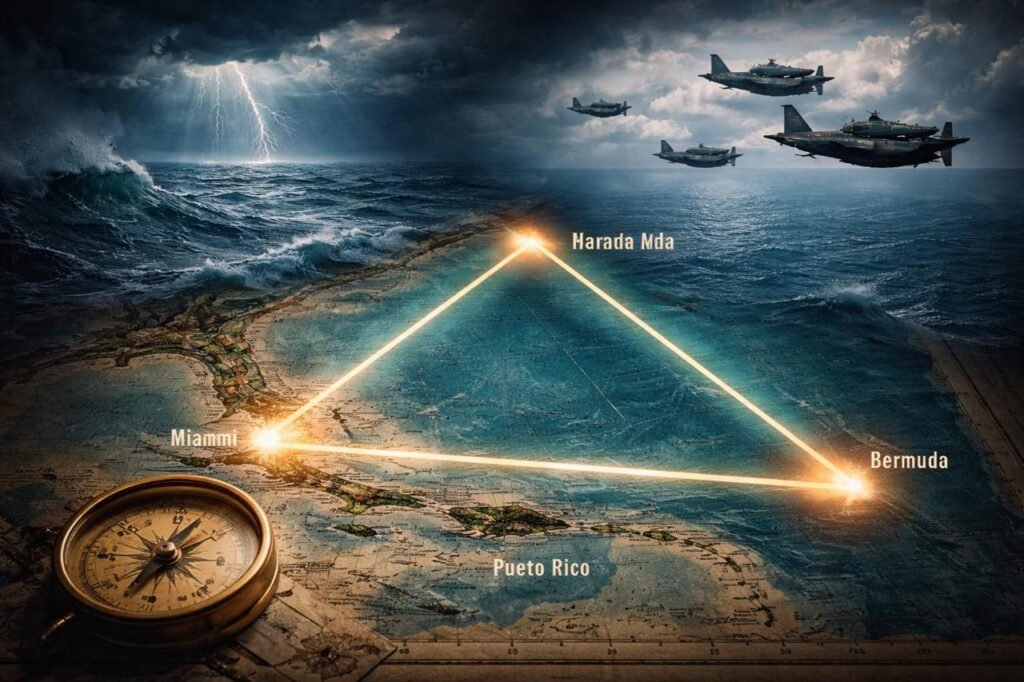
Somewhere in the Atlantic Ocean between Miami, Bermuda and Puerto Rico lies a stretch of water that has fascinated the world for more than a century. Known as the Bermuda Triangle, this region has long been associated with stories of vanished ships, missing aircraft and unexplained events. For many, it represents one of the last great mysteries of the modern world.
The legend did not begin with science fiction. Early sailors already spoke about strange experiences in these waters. Christopher Columbus himself noted unusual compass behavior during his voyage across the Atlantic. Centuries later, in 1918, the massive U.S. Navy cargo ship USS Cyclops disappeared without sending a distress signal. With more than 300 people on board, it remains one of the largest non-combat losses in naval history.
But the mystery truly captured global imagination in 1964 when a magazine article first used the term “Bermuda Triangle.” From that moment, disappearances that may once have been isolated accidents became part of a single dramatic narrative. Books, documentaries and films turned the region into a symbol of the unknown.
The most famous case is Flight 19. In December 1945, five American training aircraft took off from Florida on a routine mission. Soon after, their leader reported compass failure and confusion about location. Radio messages revealed growing panic as the pilots struggled to navigate over endless ocean with no landmarks. As daylight faded and fuel ran low, contact was lost forever. A rescue plane sent to find them also disappeared which further deepened the mystery.
Over time, imaginative explanations flourished. Some suggested giant sea creatures dragging ships underwater. Others blamed alien abductions or hidden dimensions. One theory even proposed massive methane gas bubbles rising from the ocean floor temporarily reducing water density and causing vessels to sink.
Yet scientists and historians offer a far less dramatic explanation. The Bermuda Triangle sits along one of the busiest shipping and aviation corridors on Earth. Heavy traffic naturally increases the number of accidents. The region also experiences sudden storms, hurricanes and powerful ocean currents such as the Gulf Stream which can quickly scatter wreckage beyond discovery.
Navigation challenges add another layer. In parts of the Triangle, magnetic north and true north align closely which historically confused compass readings for inexperienced navigators. Before modern GPS systems, pilots relied heavily on timing, direction and instruments that could easily fail.
The ocean itself hides evidence well. Deep trenches in the area reach thousands of meters below the surface meaning wreckage can disappear permanently. What appears mysterious may simply be unrecoverable.
Today, most experts agree that the Bermuda Triangle is not a supernatural place but a combination of natural hazards, human error and coincidence amplified by storytelling. Still, the legend refuses to fade. Humans are naturally drawn to mystery and the idea that some corners of the world remain unexplained continues to inspire curiosity.
Perhaps the true power of the Bermuda Triangle lies not in disappearing ships or aircraft but in our enduring desire to believe that the world still holds secrets waiting to be understood.
About the Author
The writer is a research enthusiast and feature contributor at Asian Burg . His write ups are majorly on science, history and global knowledge narratives. With a keen interest in simplifying complex subjects for general readers, the author explores the intersection of discovery, mystery and evidence-based understanding through engaging storytelling and analytical writing.