



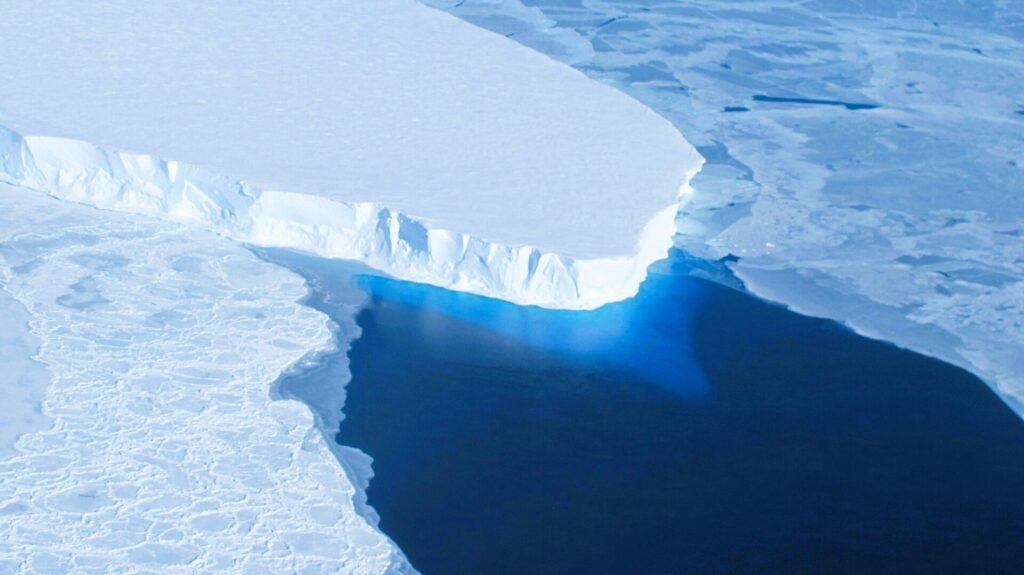
Antarctica’s enormous Thwaites Glacier is melting more aggressively than scientists had previously estimated, according to new research that could change how experts forecast future sea-level rise.
Often called the “Doomsday Glacier,” Thwaites is one of the most closely watched features of the Antarctic ice sheet. Its retreat is already contributing to rising oceans, but scientists have struggled to predict how quickly the process could accelerate because the glacier’s behaviour depends on complicated interactions between ice, seawater and the seabed beneath it.
A new study by researchers affiliated with the University of California, Irvine, and NASA’s Jet Propulsion Laboratory suggests that Thwaites could contribute up to 1.2 inches of global sea-level rise by 2100 under the model’s assumptions about twice the amount projected by earlier estimates examined in the research.
The findings, published in Nature Communications, do not mean that a catastrophic collapse is certain by the end of the century. Instead, they indicate that important processes beneath the glacier may have been inadequately represented in some existing ice-sheet models.
That distinction matters because even a relatively modest increase in sea level can intensify coastal flooding, particularly when combined with storms, high tides and other effects of climate change.
What Makes Thwaites So Important?
Located in West Antarctica, Thwaites is roughly comparable in area to the US state of Florida. Its ice loss currently accounts for around 4% of global sea-level rise, making it a significant contributor to a problem affecting coastal communities worldwide.
The glacier also plays a wider role in the stability of the Antarctic ice sheet. Its position and structure help restrain ice farther inland from flowing towards the ocean. If Thwaites retreats substantially, that loss of support could allow additional ice to move seaward, increasing the longer-term threat.
The glacier itself contains enough ice to raise global sea levels by more than two feet if it were lost entirely. The potential consequences could extend much further if its retreat destabilised surrounding parts of the Antarctic ice sheet.
However, such outcomes would unfold through complex processes over time rather than as a single sudden event. Scientists are still working to establish how quickly the glacier might retreat, how its supporting structures could change and how much additional ice loss might follow.
These uncertainties make accurate forecasting essential for coastal planning, infrastructure investment and climate adaptation.
The Hidden Zone Where Warm Water Attacks the Ice
The new research focuses on a critical area known as the glacier’s grounding zone.
A glacier’s grounding line is the boundary where ice resting on the seabed begins to float as an ice shelf. Conventional models have often represented this boundary as a relatively narrow, stable line.
But satellite observations indicate that the transition can cover a much wider area. Within this grounding zone, changing tides can lift and lower the ice, allowing seawater to move beneath it.
Scientists call this process tidal pumping. As ocean water flows into and out of spaces beneath the glacier, relatively warm seawater can penetrate areas that would otherwise be difficult to reach, accelerating melting from below.
The distinction is important because melting beneath the ice is not always directly visible from the surface. A glacier may appear to have a relatively stable boundary in one observation while the processes weakening it are already under way below.
Lead author Mattia Poinelli and his colleagues incorporated a broader grounding zone into their modelling approach to better represent these interactions. Their results suggest that accounting for this process can produce substantially different estimates of future ice loss.
The research highlights a broader challenge for climate science: projections depend not only on the quality of observations but also on whether models accurately represent the physical processes driving change.
An Underwater Ridge Could Lose Its Grip
Thwaites does not retreat across a simple, flat landscape. The seabed beneath it has a complicated shape, including ridges that help hold back the glacier as ice flows towards the ocean.
One of these features, known as Mouginot Ridge, currently acts as an important point of support. The new study suggests that melting within the grounding zone is helping to weaken the glacier’s attachment to this ridge.
According to the researchers’ model, there is a 60% probability that Thwaites will become unpinned from Mouginot Ridge by the end of the century.
If that happens, the glacier could retreat more rapidly across the sloping bedrock towards another major ridge. As the grounding zone moves inland over deeper sections of the seabed, more ice may become exposed to ocean water, potentially encouraging further retreat.
This process could create a feedback loop in which melting weakens the glacier’s support, retreat exposes additional ice to seawater and further melting makes continued retreat more likely.
The model does not establish exactly when this transition will occur. Instead, it identifies a significant risk that scientists need to investigate more closely.
Why an Extra Inch of Sea-Level Rise Matters
An increase of 1.2 inches may appear small compared with the height of a sea wall or the depth of a coastal harbour. But global sea-level rise changes the starting point from which tides and storms operate.
When average sea levels rise, storm surges can reach farther inland, coastal flooding can become more frequent and drainage systems can face greater pressure. Communities already exposed to high tides or land subsidence may face particularly serious challenges.
The effects would not be distributed evenly. Local geography, infrastructure, coastal protection and the ability to adapt all influence how rising seas affect people and property.
Eric Rignot, one of the study’s authors and a professor of Earth system science at UC Irvine, said the findings point to greater coastal flood exposure than previously anticipated in the coming decades.
The research also reinforces the need to distinguish between the direct contribution of Thwaites and the wider consequences of its retreat. The glacier’s own ice loss is only one part of the potential long-term impact if changes in its structure affect neighbouring ice.
For governments and planners, the lesson is not that every coastal community faces the same immediate danger. It is that projections based on incomplete understanding of Antarctic ice loss could underestimate future risks.
Scientists Still Need to Look Beneath the Glacier
Researchers outside the study have welcomed the effort to improve sea-level forecasts while warning that the environment beneath Thwaites remains poorly understood.
Ted Scambos, a senior research scientist at the University of Colorado Boulder, described the findings as potentially important for forecasting future sea-level rise. Robert Larter, a marine geophysicist at the British Antarctic Survey, stressed that scientists still need more direct observations before they can confidently predict how quickly ice will be lost.
Collecting those observations is difficult. Thwaites lies in a remote part of Antarctica, where extreme conditions complicate access and long-term monitoring.
The research team plans to travel to the region in 2028 to deploy instruments capable of recording how seawater moves beneath the glacier. Such measurements could help determine whether the processes represented in the model match what is happening in reality.
Direct observations would also help scientists assess how different sections of the grounding zone respond to tides, ocean temperatures and changes in the glacier’s position.
Climate Action Still Matters
The new findings add urgency to the challenge of limiting global warming, but they do not suggest that the future is already fixed.
Even if global emissions fell sharply, some sea-level rise would continue because of warming and ice loss already set in motion. Cutting planet-heating pollution can nevertheless limit additional warming and reduce the risks facing future generations.
At the same time, coastal communities need to prepare for changes that are already under way. Better flood-risk mapping, stronger infrastructure, thoughtful land-use planning and long-term adaptation strategies can help reduce the damage from rising seas.
Thwaites Glacier demonstrates why climate forecasting must continue to improve. What happens beneath the ice can shape risks thousands of kilometres away and processes that once seemed secondary may turn out to be central to understanding the future.
The glacier has not been declared certain to collapse by 2100. But the possibility that its contribution to sea-level rise has been underestimated is a serious warning one that makes continued research, emissions reductions and coastal preparedness increasingly important.
Keywords: Thwaites Glacier, Doomsday Glacier, Antarctica ice melt, sea-level rise, climate change, grounding zone, coastal flooding, Antarctic ice sheet
Asian Burg / International