


Walk through a supermarket and it can be difficult to know exactly why some foods look unusually bright, white or opaque. One ingredient that has attracted growing attention from food-safety organisations is titanium dioxide, a colouring additive used to improve the appearance of certain products.
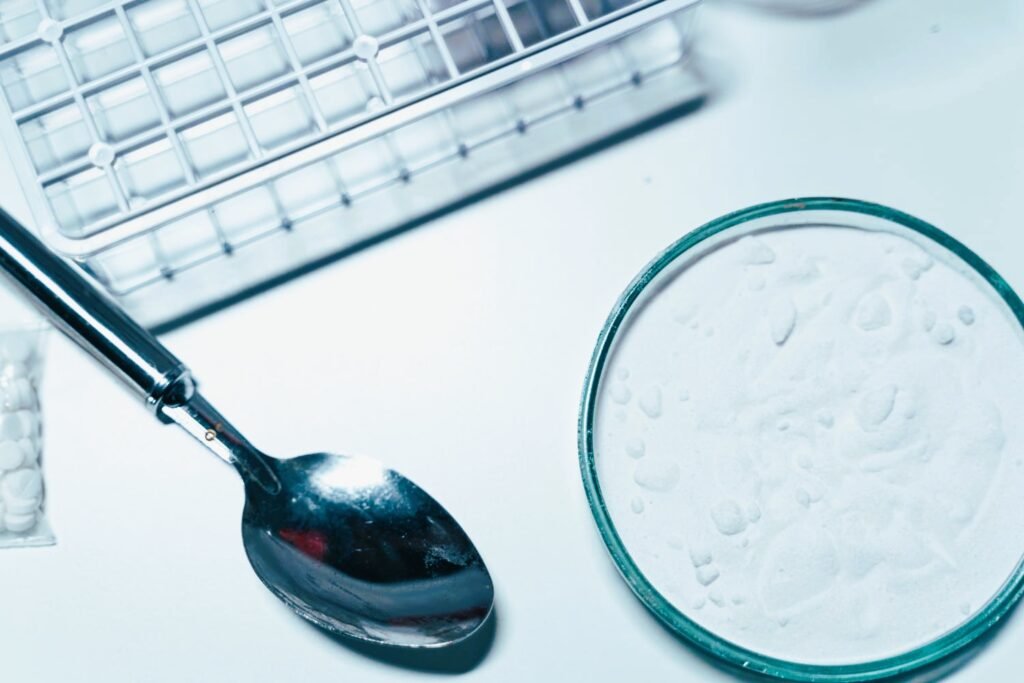
Titanium dioxide, also known as TiO₂, does not provide nutritional value or act as a preservative. Its primary purpose in food is cosmetic: it can make products appear whiter, brighter or more opaque.
According to the Center for Science in the Public Interest (CSPI), the ingredient is used in thousands of food products sold in the United States. The organisation says a US Department of Agriculture database lists titanium dioxide in roughly 13,000 branded food products, although the actual number may be higher because companies can sometimes identify colour additives using broader terms such as “artificial color.”
Why is titanium dioxide controversial?
The safety debate largely concerns very small particles of titanium dioxide, including nanoparticles and what may happen when they are repeatedly consumed.
The European Food Safety Authority (EFSA) concluded in 2021 that titanium dioxide, previously known as food additive E171 in Europe, could no longer be considered safe as a food additive because the possibility of genotoxicity damage to genetic material could not be ruled out.
CSPI points to this assessment in recommending that consumers avoid foods containing titanium dioxide.
The issue is not simply the colour itself. Researchers and regulators have been concerned about whether tiny particles can remain in the body and potentially interact with cells and biological systems.
However, food-safety rules differ between jurisdictions. Titanium dioxide has historically been permitted as a food colour additive in the United States, subject to regulatory requirements.
That means consumers in countries where the additive remains permitted may encounter it in ordinary supermarket products.
Which foods may contain titanium dioxide?
The additive is not restricted to one particular category of food. It can appear in products ranging from prepared meals and sauces to sweets and baked goods.
Examples identified by CSPI include:
Macaroni and cheese
Some packaged macaroni and cheese products have used titanium dioxide to enhance their appearance. Other products in the same category are manufactured without it, demonstrating that the ingredient is not essential to producing the food.
Soups
Certain prepared soups use titanium dioxide as a colouring ingredient. Other brands offer visually similar products without the additive, although they may contain different colouring agents.
Pastries and baked goods
Some packaged Danish pastries and similar products have contained titanium dioxide. Alternatives without the ingredient are also available.
Packaged cheese
Titanium dioxide has been used in some shredded or processed cheese products to influence colour. Consumers can find comparable products that do not list the additive.
Gravy and prepared sauces
Some packaged gravy products use titanium dioxide as a colouring agent, while other versions are made without it.
Children’s meals
Certain packaged children’s meal kits have been found to contain the additive, while other products from the same broader category do not.
This has drawn particular attention from food-safety advocates because children can consume processed and packaged foods regularly.
Snack mixes and cookies
Titanium dioxide can also appear in colourful chocolate candies used in snack mixes and in some packaged cookies or snack cakes.
The important point is that the presence of titanium dioxide depends on the specific product and formulation. A food category cannot automatically be classified as containing or being free of the additive.
How can consumers identify it?
Checking the ingredient list is one of the simplest ways to determine whether a packaged food contains titanium dioxide.
Look for terms such as “titanium dioxide” and depending on the country’s labelling rules, references to colour additives.
Consumers should also remember that food formulations can change. A product that previously contained an additive may later be reformulated, while another product may introduce one.
For that reason, checking the current packaging is more reliable than relying solely on older ingredient lists or online product descriptions.
Does avoiding titanium dioxide mean a food is healthy?
A product without titanium dioxide can still contain high levels of sugar, sodium, saturated fat or other additives. Removing one colouring ingredient does not automatically turn a highly processed food into a nutritious choice.
The broader lesson is that food labels matter.
Titanium dioxide is primarily used to change how food looks rather than how nutritious it is. That distinction has become central to the debate over whether consumers should be exposed to unnecessary additives when comparable products can be made without them.
For consumers who want to reduce their exposure, comparing ingredient lists and choosing products without titanium dioxide is one practical approach.
At the policy level, the debate is larger. It concerns how regulators assess uncertainty, how manufacturers use cosmetic ingredients and how much information consumers should receive about substances added to everyday food.
As scientific research and regulatory decisions continue to evolve, the ingredient remains an example of a wider question facing the modern food industry: how much should appearance matter when an ingredient provides no nutritional benefit?
Keywords: titanium dioxide, titanium dioxide in food, food additives, E171, food safety, artificial food coloring, food ingredients, titanium dioxide health risks, processed foods, food labels
Asian Burg / Health