




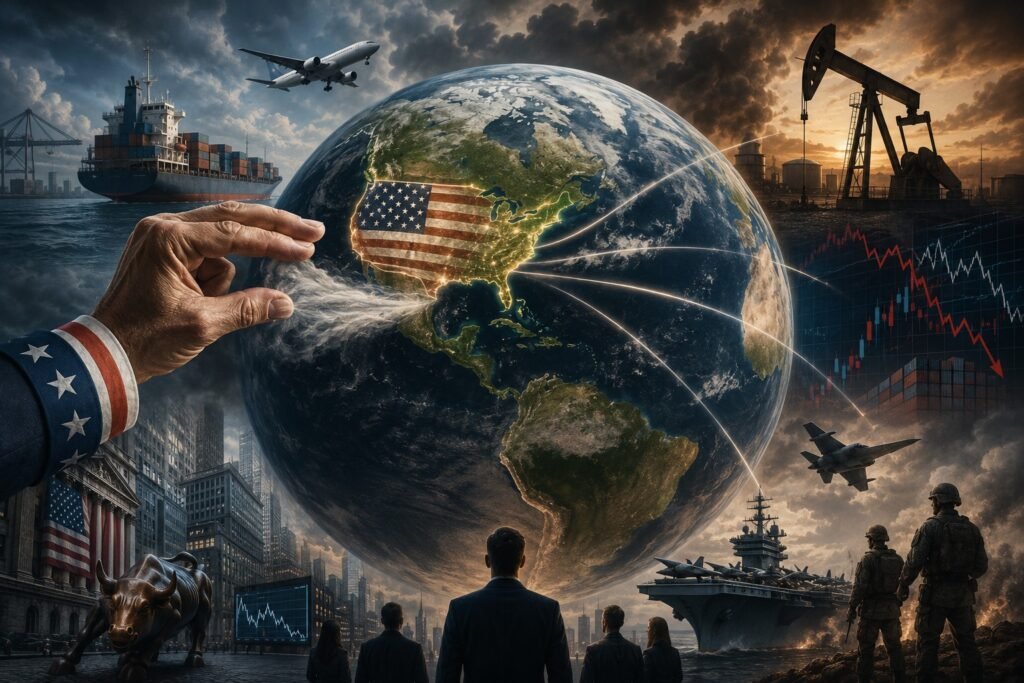
The phrase “when America sneezes, the world catches a cold” is often repeated in discussions on global economics but it remains more than just a metaphor. It reflects a structural reality that the modern global system is deeply tied to the economic and political weight of the United States.
From an opinion standpoint, the persistence of this dynamic raises an uncomfortable truth. Despite increasing talk of multipolarity, the world has not meaningfully decoupled from American influence. Instead, it has become more interconnected making shocks from Washington faster and more far-reaching than ever before.
At the centre of this influence lies the dominance of the US dollar. As the world’s primary reserve currency, it anchors global trade, debt, and financial systems. Decisions by the Federal Reserve are therefore not domestic policy choices alone they are global economic events. When interest rates rise in the United States, capital flows shift, currencies weaken in emerging markets and debt burdens intensify almost instantly.
This pattern is not theoretical. The 2008 Global Financial Crisis demonstrated how vulnerabilities within the American financial system could cascade across continents. What began as a housing crisis quickly evolved into a synchronized global recession, exposing the depth of systemic dependence on US financial stability.
Energy markets further reinforce this interconnectedness. Oil prices, largely denominated in dollars, remain sensitive to US geopolitical actions. Sanctions regimes, particularly those targeting countries like Iran and Russia, frequently trigger global price volatility. This, in turn, feeds into inflation, trade imbalances and fiscal strain across both developed and developing economies.
The geopolitical dimension is equally significant. The War on Terror reshaped global security priorities for decades, influencing alliances, conflicts, and migration patterns far beyond its initial theatres. It underscored how US strategic decisions can redefine international order not just respond to it.
More recently, competition between the United States and China has added another layer to this influence. Trade restrictions, technology controls and supply chain shifts driven by Washington have forced countries and corporations worldwide to rethink economic strategies. The ripple effects are visible in manufacturing relocations, investment patterns and emerging technological blocs.
Even in routine circumstances, global markets remain psychologically tethered to the United States. Movements in Wall Street, shifts in inflation data or signals from central bank officials can influence investor sentiment across continents within hours. This reflects not just economic power but systemic centrality.
Yet, it would be simplistic to view this as absolute dominance. The global system is gradually evolving with new centres of power emerging. However, evolution is not replacement. The United States continues to operate as a core node within financial systems, security networks and technological ecosystems.
Ultimately, the phrase endures because it captures a structural imbalance that has yet to be resolved. The world may be diversifying, but it is still deeply synchronized with American decisions.
In practical terms, when the United States adjusts its economic or strategic posture, the effects do not remain contained they are transmitted, absorbed and reflected across the global system with remarkable speed.
Keywords:
US global influence, dollar dominance global economy, Federal Reserve impact world, global financial crisis 2008 analysis, US China trade war effects, global markets US policy impact, oil prices US sanctions, international relations US power, emerging markets capital flows, geopolitical influence United States
Asian Burg | Global Affairs