




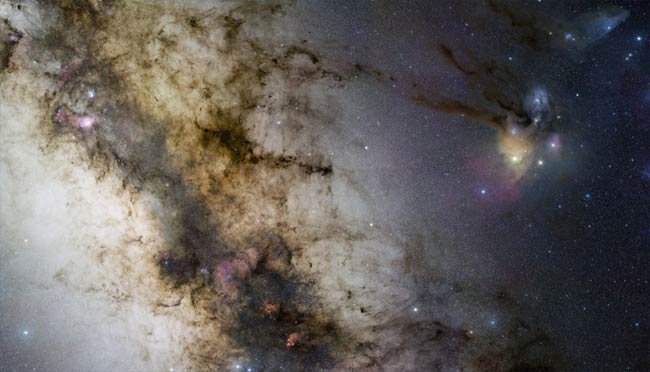
A new astronomical study suggests that the Milky Way may have consumed another ancient galaxy billions of years ago leaving behind stellar remnants that scientists are only now beginning to identify.
Researchers have identified a unique group of metal-poor stars that appear to be the remains of a dwarf galaxy, which astronomers have nicknamed “Loki,” inspired by the trickster figure from Loki.
The discovery provides fresh insight into how the Milky Way evolved over billions of years through a process often described as galactic cannibalism where larger galaxies absorb smaller ones using gravitational forces.
The Milky Way, which spans roughly 100,000 light-years and contains hundreds of billions of stars, did not form in isolation. Scientists believe it gradually grew by merging with multiple smaller galaxies in the early universe.
To uncover this hidden history, astronomers analyzed data from the Gaia mission, which has mapped nearly two billion stars. They focused on unusually old, metal-poor stars located close to the galaxy’s disk an unexpected finding since such stars are typically found in the outer halo.
These stars are estimated to be more than 10 billion years old and share similar chemical compositions suggesting they originated from the same ancient galaxy.
Interestingly, some of these stars orbit the galaxy in the same direction as the Milky Way’s rotation, while others move in the opposite direction. This unusual pattern supports the theory that they were scattered during a massive merger event early in the galaxy’s history.
Scientists believe this merger likely occurred just a few billion years after the Big Bang, when the Milky Way was still relatively small and less gravitationally stable.
If confirmed, the “Loki” galaxy could represent one of the major building blocks of the Milky Way, similar in scale to previously known merger events like the Gaia-Sausage-Enceladus collision.
Experts say studying these ancient stellar remnants is like piecing together a cosmic puzzle. Each discovery helps astronomers better understand how galaxies form, evolve and interact over time.
However, researchers caution that further data is needed to confirm whether these stars truly originated from a single galaxy or multiple merger events.
The findings highlight how much of the Milky Way’s past remains hidden and how modern space missions are gradually uncovering its complex and violent history.
Keywords:
Milky Way galaxy merger
Loki dwarf galaxy discovery
galactic cannibalism explained
metal poor stars Milky Way
Gaia telescope discoveries
galaxy evolution history
Milky Way formation theory
ancient galaxy remnants
space science discoveries
Big Bang galaxy mergers
Asian Burg | Science / Space
Send your feedback via email info@asianburg.com