




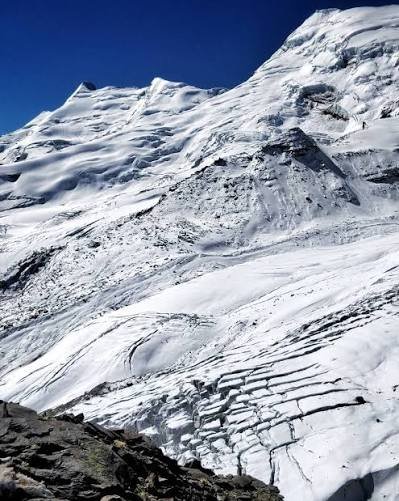
Climate change in the Himalayas is no longer a distant scientific concern it is a visible and immediate reality affecting culture, faith and livelihoods. In recent years, one of the most striking examples has been the rapid shrinking of the sacred ice formation at the Amarnath cave in Jammu and Kashmir. Revered by millions of Hindu pilgrims as a manifestation of Lord Shiva, this natural structure has been melting earlier each year. In July alone, it reduced dramatically within days, continuing a worrying trend observed over the past several years.
This is not an isolated environmental shift. It reflects a deeper transformation where rising temperatures, reduced snowfall and increasing human activity are converging to reshape the fragile Himalayan ecosystem. The Amarnath Yatra, one of the region’s oldest and most significant religious pilgrimages has evolved over centuries into a large-scale annual event drawing hundreds of thousands of visitors. Similarly, the Vaishno Devi pilgrimage attracts millions each year, making religious tourism a cornerstone of the regional economy.
However, the growing scale of these pilgrimages is placing additional pressure on already vulnerable mountain environments. Scientific observations suggest that the sheer number of pilgrims passing through confined spaces like the Amarnath cave can raise local temperatures, accelerating the melting of the ice formation. At the same time, extreme weather events including landslides and heavy rainfall are becoming more frequent, disrupting pilgrimage routes and threatening safety.
These environmental changes are not only affecting physical landscapes but also eroding cultural and spiritual experiences. The Himalayan pilgrimage is deeply rooted in tradition, passed down through generations as a sacred journey tied to specific places and natural conditions. As glaciers retreat, routes become unstable and weather patterns grow unpredictable, the continuity of these traditions is increasingly at risk.
The economic implications are equally significant. Tourism contributes a substantial share to the economy of Jammu and Kashmir with religious tourism forming a major part of this sector. Millions of visitors traveling to sites like Amarnath and Vaishno Devi generate income for local communities from transport and accommodation to small businesses. However, an economy heavily dependent on climate-sensitive locations faces growing uncertainty as environmental conditions deteriorate.
Globally, similar patterns are emerging. Rising temperatures have already impacted major religious gatherings, including extreme heat events during pilgrimages in other parts of the world. In the Himalayas, past disasters such as floods and landslides have demonstrated how quickly natural events can disrupt both human life and economic stability. These incidents are increasingly linked to broader climate trends, including glacier melt and changing monsoon patterns.
The challenge lies not only in responding to disasters but in rethinking how pilgrimage and tourism are managed in a changing climate. Traditional approaches that focus solely on expanding infrastructure or increasing visitor capacity may no longer be sustainable. Instead, there is a growing need to balance environmental protection with cultural preservation and economic development.
Some experts suggest that the solution is not simply reducing the number of pilgrims but redesigning the entire pilgrimage economy to protect both tangible and intangible heritage. This includes safeguarding natural features such as glaciers and mountain trails, while also preserving the spiritual and cultural significance of these journeys.
Climate change is forcing a fundamental question: how can societies maintain their traditions in environments that are rapidly changing? In the Himalayas, where nature, faith and livelihood are deeply interconnected, the answer will shape not only the future of pilgrimage but also the sustainability of the region itself.
As temperatures continue to rise and environmental pressures intensify, the transformation of these sacred landscapes serves as a powerful reminder that climate change is not just an environmental issue it is a cultural and human one as well.
Keywords:
climate change Himalayas, Amarnath Yatra climate impact, Vaishno Devi tourism, melting glaciers Himalayas, religious tourism India, climate change culture, Himalayan ecosystems, pilgrimage and environment, global warming India, mountain tourism crisis, climate change effects tourism, sacred sites climate risk
Asian Burg \ Climate Change / Environment