




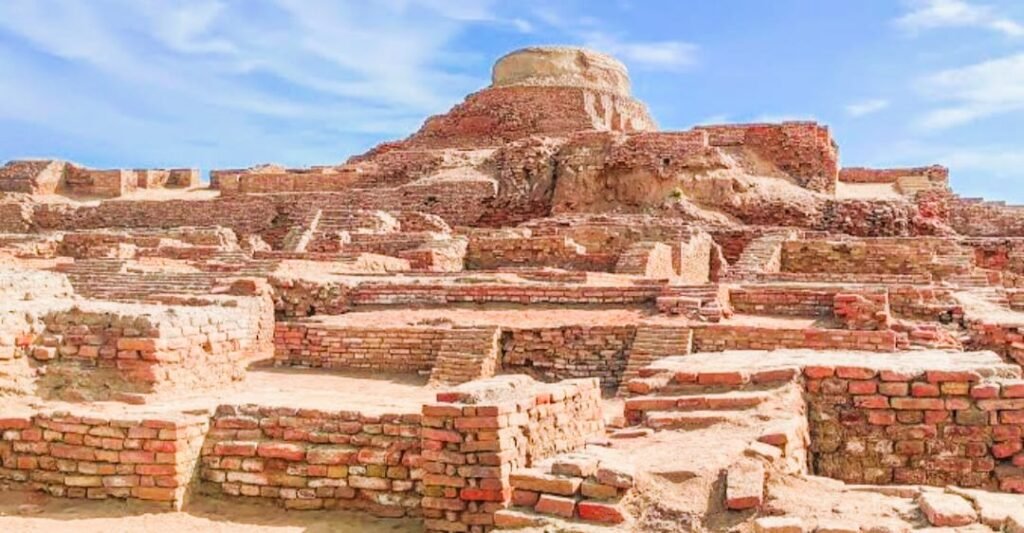
Four thousand years ago, a remarkable urban civilisation flourished across the plains of present-day Pakistan and northwestern India. Its people constructed carefully planned cities, developed sophisticated drainage systems, used standardised weights and traded goods across vast distances. Their settlements displayed a level of organisation that continues to impress archaeologists today.
Then the great cities began to change.
By around 1900 BCE, the mature urban phase of the Indus civilisation was giving way to a different pattern of settlement. Large cities lost prominence, long-distance commercial networks changed and communities increasingly lived in smaller settlements. Yet archaeologists have found no convincing evidence of one final battle or a single catastrophe that destroyed the entire civilisation.
The mystery is not simply why its cities declined. It is how a society that had organised urban life on such an impressive scale gradually reorganised itself and why its people left behind so few written clues to explain what happened.
A Lost Civilisation Emerges From the Earth
The modern discovery of the Indus civilisation transformed the understanding of South Asian history.
In the early twentieth century, excavations at Harappa and Mohenjo-daro revealed extensive settlements far older than many researchers had previously recognised. Archaeologist Rakhal Das Banerji played a major role in the early investigations at Mohenjo-daro, while subsequent work at Harappa helped establish the scale and significance of the archaeological culture.
The civilisation takes its name from the Indus River, which shaped much of the region and from Harappa, one of its best-known archaeological sites. Its mature urban period flourished approximately between 2600 and 1900 BCE, although communities associated with the wider Harappan tradition existed before and after these dates.
Its territory covered a vast area of South Asia, including much of present-day Pakistan and parts of northwestern India with related settlements extending toward neighbouring regions.
Mohenjo-daro and Harappa were among its major urban centres but they were not isolated cities. They belonged to a broad network of settlements linked through shared technologies, craft traditions, measurements and commercial relationships.
The discovery revealed that the ancient world had supported another major urban civilisation alongside those of Egypt and Mesopotamia.
Cities Built With Remarkable Precision
The streets of Mohenjo-daro reveal a society that understood the value of planning. Many streets followed organised layouts, buildings used bricks made to remarkably consistent proportions and drainage channels formed part of the wider urban infrastructure.
Wells supplied water, while drains and bathing areas suggest that managing water was an important part of everyday life. The impressive feature was not any single invention but the recurrence of similar construction practices across settlements separated by considerable distances.
Standardised stone weights provide another clue to the civilisation’s organisation. Their consistency suggests that merchants and craftspeople shared systems of measurement, helping goods move between communities with a degree of predictability.
The Harappans also participated in long-distance trade. Archaeological finds and Mesopotamian records point to commercial connections between the Indus region and western Asia. Some Mesopotamian texts mention a trading land called Meluhha, which many scholars associate with the Indus civilisation, although details of that relationship remain under investigation.
Beads, ornaments, pottery, metals and other materials reveal a world in which specialist crafts and exchange connected urban populations to distant markets.
These cities were not simply impressive collections of buildings. They were centres of production, administration and daily activity supported by systems that extended far beyond their walls.
The Great Bath and the Mystery of Power
One of Mohenjo-daro’s best-known structures is the Great Bath, a large, carefully constructed pool made with fired bricks and waterproofing materials. Its design demonstrates considerable engineering skill, but its exact purpose remains uncertain.
A ceremonial or communal function is often proposed, although the evidence does not establish precisely how the structure was used.
The wider city presents another puzzle. Unlike ancient Egypt, with its monumental royal tombs, or parts of Mesopotamia with inscriptions celebrating kings and military campaigns, the Indus civilisation has yielded no undisputed royal palace or extensive collection of royal records.
That absence does not prove that Harappan society lacked rulers, social divisions or political authority. It means archaeologists cannot yet reconstruct its governing institutions with confidence.
The civilisation clearly coordinated construction, craft production and trade on a substantial scale. How it organised that work whether through powerful central authorities, networks of local leaders or another arrangement remains an open question.
Its achievements are visible. The political system behind them is much harder to recover.
Ordinary Lives Behind the Ancient Bricks
The Indus civilisation was not made only of streets, drains and commercial networks. It was also a world of households, workshops, farms and neighbourhoods.`
Farmers cultivated crops and raised animals. Potters produced vessels for domestic use and trade, while skilled craftspeople worked materials such as carnelian, gold and lapis lazuli into ornaments and other objects.
Archaeologists have also recovered small toys, including clay animals and miniature wheeled carts. These modest objects provide a glimpse of everyday experiences that monumental architecture cannot reveal.
Seals bearing animals and other symbols, beads fashioned with great precision and pottery made for ordinary use all suggest a society with diverse skills and established traditions.
Such finds help bring the ancient population into focus. The people who inhabited these settlements were not merely participants in an archaeological mystery. They were individuals who worked, traded, raised children and adapted to changing circumstances.
When Rivers and Rainfall Began to Change
Environmental change is one of the leading explanations for the decline of Harappan urbanism, although it is not a complete answer on its own.
Research indicates that changes in the South Asian monsoon reduced the reliability of rainfall in parts of the region over time. Because agriculture depended on seasonal water, shifts in rainfall patterns could have placed pressure on farming communities and the urban centres they supported.
River systems also changed. The Ghaggar-Hakra region, where many Harappan settlements have been identified along ancient river courses, remains central to debates about settlement distribution and environmental change. However, the timing and causes of individual river shifts are complex and researchers continue to investigate the roles of changing channels, tectonic processes and long-term climate patterns.
It would be misleading to imagine every Harappan city suddenly running out of water at the same moment. Different settlements occupied different landscapes and relied on different combinations of rainfall, rivers, wells and local resources.
Environmental pressure may have made some locations less attractive or harder to sustain, encouraging people to move, diversify their livelihoods or reorganise their communities. Changes in trade and economic relationships may also have weakened the networks that supported major cities.
The evidence points toward a gradual, uneven transformation rather than one universal disaster.
Not a Single Invasion, but a Changing Urban World
Older explanations sometimes attributed the decline of the Indus civilisation to an invading force. Scattered human remains discovered at Mohenjo-daro were once interpreted as evidence of a massacre associated with the city’s destruction.
Later archaeological assessments have challenged that interpretation. The remains do not establish one identifiable mass killing that explains the decline of the entire civilisation.
Instead, the broader archaeological record shows changes unfolding across different regions and periods. Major urban centres lost prominence, some settlement areas were abandoned and populations became more dispersed.
Craft production and trade also changed. The standardised systems associated with the mature urban phase became less widespread, while local traditions developed in different directions.
This transition is often described as de-urbanisation: a decline in large urban centres and the systems that connected them. It does not mean that every city was destroyed or that every community disappeared.
By around 1900 BCE, the mature urban system was declining but Harappan communities continued to inhabit the region for centuries. Their lives and settlements followed new patterns shaped by local conditions and changing economic opportunities.
One Civilisation, Many Different Endings
The transformation did not occur identically everywhere.
At Harappa, archaeological layers reveal changes in settlement organisation, material culture and production. Mohenjo-daro experienced its own pattern of decline, while other settlements followed different trajectories.
Dholavira, in present-day Gujarat, is particularly notable for its sophisticated water-management infrastructure, including reservoirs designed to capture and store water. Its history also reflects changes in occupation and settlement before eventual abandonment.
These differences matter because they challenge the idea that the Indus civilisation ended on one decisive day. The urban network covered a vast territory, and communities faced different environmental conditions, commercial pressures and local circumstances.
Some places may have become increasingly difficult to sustain, others may have lost their economic importance as trade networks changed. In many areas, people continued living in smaller settlements rather than abandoning the wider region.
The end of Harappan urbanism was therefore a collection of related regional transformations, not one event that brought an entire civilisation to an immediate halt.
The Script That Still Cannot Be Read
Perhaps the greatest obstacle to understanding the Indus civilisation is its undeciphered script.
Short inscriptions appear on seals, pottery and other objects. Researchers have identified recurring signs and patterns but no interpretation has achieved broad scholarly acceptance that would allow the inscriptions to be read with confidence.
The language or languages represented remain uncertain. Because the inscriptions are generally short, there is also limited material with which to test proposed decipherments.
This leaves historians with an unusual challenge. They can study the dimensions of buildings, the composition of artefacts, the distribution of settlements and evidence of trade but they cannot reliably read the words of the people who created them.
A seal depicting a seated figure surrounded by animals, for example, has inspired numerous interpretations. Yet its precise meaning remains unresolved.
The script’s silence limits what can be said about Harappan beliefs, political institutions, historical events and how its inhabitants understood the changes taking place around them.
Archaeology has recovered much of the civilisation’s material world. Its written voice remains elusive.
The Cities Declined. The People Did Not Simply Vanish.
The distinction between the decline of a civilisation’s cities and the disappearance of its population is essential.
The end of the mature urban phase did not mean that all Harappan communities died, fled the region or abandoned their cultural traditions. People continued living across South Asia and elements of material culture and established practices persisted in changing forms.
The extent to which particular traditions continued and how they relate to later South Asian populations and cultures, must be examined carefully rather than reduced to a simple claim of uninterrupted continuity.
What the archaeological record makes clear is that urban decline and population disappearance are not the same thing. A society can lose its major cities while its people adapt to different ways of living.
In the Indus region, the transformation involved changing settlement patterns, economies and local traditions. The urban system faded but the region remained inhabited.
A Mystery That Survives Four Thousand Years
More than a century after the major archaeological discoveries at Harappa and Mohenjo-daro, the Indus civilisation still resists a single, definitive explanation for its decline.
Climate change appears to have influenced living conditions. Changes in rivers and rainfall may have affected agriculture and settlement choices. Economic networks shifted and urban institutions gradually gave way to different forms of community life.
The relative importance of these factors likely varied from place to place. The undeciphered script means that the people themselves cannot yet tell us how they understood their changing world.
Yet the civilisation has left abundant evidence of its achievements. Its brickwork reveals standardisation, its wells and drains demonstrate practical engineering, its weights point to shared commercial systems and its toys preserve fragments of domestic life.
These objects do not provide a final answer, but they prevent the story from becoming one of simple disappearance.
The great cities of the Indus were not necessarily defeated in a final battle or erased by a single catastrophe. They belonged to a complex society that changed as its environment, economy and communities changed.
Four thousand years later, the most compelling part of the mystery may not be that the civilisation vanished but that its people adapted while the urban world they had built slowly came apart.
The Indus civilisation left behind its streets, its tools, its ornaments and its still-unread signs. What it did not leave was a clear account of why its great cities declined. That unanswered question continues to draw us back to the ancient bricks, where the evidence of a remarkable civilisation survives and its final chapter remains unfinished.
Keywords: Indus Valley civilisation, Harappan civilisation, Mohenjo-daro, Harappa, ancient Pakistan, Indus civilisation collapse, Bronze Age history, Indus script, ancient urban planning
Munir Hussain Chopra

About Author:
Mr. Hussain is a mid-career civil servant with a keen interest in public policy, governance, socioeconomic issues and institutional reform. His writings focus on analyzing contemporary challenges through the lens of policy, administration and social impact aiming to encourage informed public discourse.
Asian Burg / Knowledge Hub