



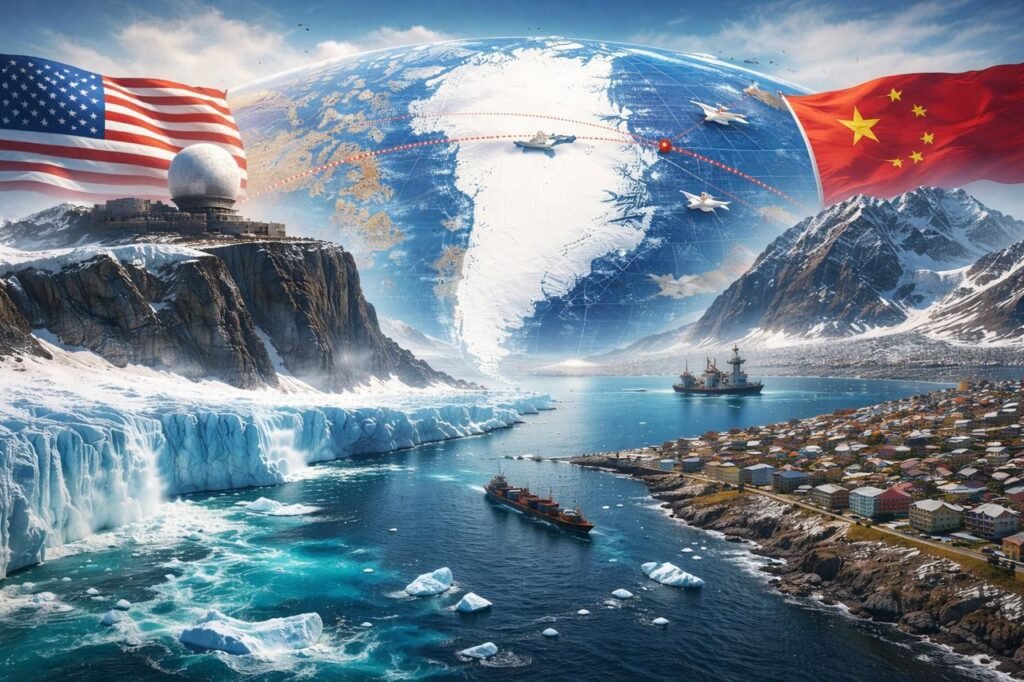
What once appeared to be an icy, distant land with little global relevance has quietly transformed into one of the most discussed strategic spaces in contemporary geopolitics. Greenland today is no longer merely a geographical curiosity rather it is a symbol of how climate change, military strategy and international law are redrawing the world’s power map.
The melting of Arctic ice has altered calculations that remained static for decades. New shipping routes are opening, distances between continents are shrinking and access to rare earth minerals and untapped energy reserves is becoming feasible. In a century where technology depends on critical minerals and supply chains are increasingly weaponized, control over resources is not just economic strength but it is geopolitical leverage. Greenland sits at the crossroads of this transformation.
The consistent interest shown by the United States, including high-profile remarks during previous administrations is not impulsive rhetoric but rooted in strategic continuity. Greenland hosts early-warning defense systems, provides vantage points to monitor Arctic military activity and acts as a northern shield within NATO’s security architecture. With Russia strengthening its Arctic presence and China declaring itself a “near-Arctic state,” Washington views Greenland less as territory and more as infrastructure of balance.
However, geopolitics does not operate in a legal vacuum. Greenland remains an autonomous territory under Denmark with internationally recognized rights of self-determination. Any attempt to change its status without consent would not merely provoke diplomatic tension and it would challenge the very norms that emerged after World War II to prevent territorial coercion. In this sense, Greenland represents the tension between power ambition and legal boundaries.
For Pakistan, the Greenland discourse carries an understated but vital lesson. Strategic value is not static — it evolves with climate, technology and global priorities. Regions once overlooked can become pivotal overnight. Pakistan’s own geography, connecting South Asia, Central Asia, the Middle East and the Arabian Sea, holds comparable latent potential. Yet geography alone does not guarantee influence. Without policy coherence, institutional capacity and economic strength, location becomes opportunity wasted rather than advantage realized.
Greenland ultimately illustrates a broader truth: environmental change is no longer only an ecological issue; it is a geopolitical accelerator. Nations that anticipate these shifts position themselves as stakeholders. Those that ignore them risk becoming spectators. For countries like Pakistan, the message is clear — strategic awareness must precede strategic relevance.