




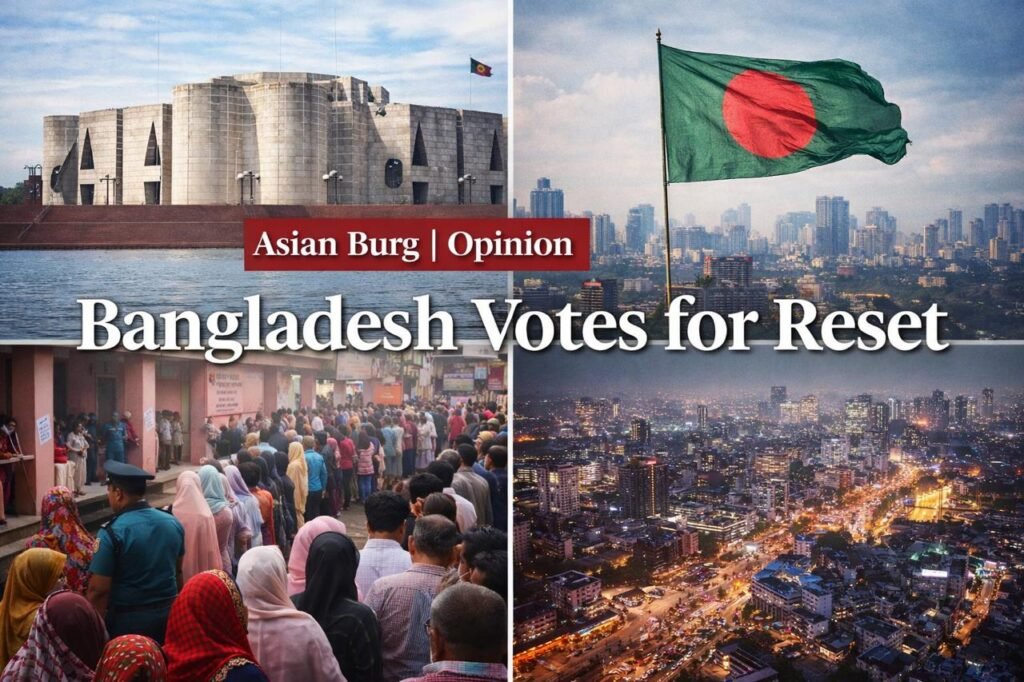
Bangladesh’s latest parliamentary election has delivered a decisive verdict. The sweeping victory of the Bangladesh Nationalist Party (BNP)securing a two-thirds majority in the Jatiya Sangsad, is more than a routine change of government.It represents a collective public desire for political reset after a turbulent phase marked by protests, economic disruption and generational unrest.
This was the first national vote since the youth-led upheaval of 2024 that unseated a long-entrenched leadership and shook the country’s political architecture. The high turnout and competitive field — with dozens of parties and thousands of candidates — suggest that voters were less interested in personalities and more focused on restoring normalcy to daily life and reviving economic confidence, particularly in export-driven industries such as garments that felt the strain of prolonged instability.
A Mandate with Expectations
The BNP’s campaign promises — economic revival, foreign investment, anti-corruption measures and a proposed limit on prime-ministerial tenure — reflect a shift toward governance reform rather than ideological confrontation. Equally notable is the party’s call for restraint after victory, discouraging celebratory rallies and urging national prayers instead. Symbolically, it signals awareness that public patience is finite and expectations are immediate.
Opposition Without Obstruction
The concession by Jamaat-i-Islami and its pledge of “positive politics” lowers the temperature in a polity long accustomed to zero-sum rivalries. While the youth-driven National Citizen Party underperformed electorally, its earlier role in catalysing change indicates that generational influence will persist outside formal parliamentary numbers. Bangladesh’s political future, therefore, may increasingly be shaped by civic pressure as much as by party arithmetic.
Reform on the Ballot
Parallel constitutional proposals — including a neutral interim government during elections, stronger judicial independence and greater women’s representation — hint at institutional recalibration. Even without final official tallies, early indications of public support for reforms underscore a societal appetite for rules that outlast rulers.
Regional and Strategic Ripples
Former premier Sheikh Hasina’s denunciation of the election from exile keeps the narrative contested yet it also reveals the broader geopolitical undertone. Strained ties with traditional partners and the prospect of new external alignments mean that Dhaka’s domestic choices will inevitably carry regional consequences. Stability at home will be the strongest currency in managing these external equations.
The Real Test Begins Now
Elections can change governments overnight; they do not change systems as quickly. Bangladesh’s new leadership inherits a mandate born of hope but constrained by economic realities and institutional fragility. Delivering tangible improvements — jobs, inflation control, governance transparency will determine whether this landslide becomes a turning point or merely another cycle in a familiar political rhythm.
For Bangladesh, the vote is less a finish line than a starting gun. The electorate has signalled readiness for reform; the durability of this moment will depend on whether power translates into policy and policy into public trust.
_Asian Burg/ Beyond Headlines.