




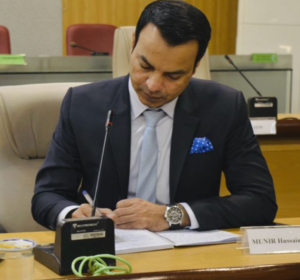
Munir Hussain Chopra
The CSS (Central Superior Services) examination remains Pakistan’s most prestigious gateway into the country’s civil bureaucracy. For decades, the provincial quota system has been an integral part of this structure. Its original objective was clear: to provide representation to regions that historically lagged behind in educational facilities, infrastructure and access to opportunities.
At the time of its introduction, the logic was understandable. Pakistan is a country with significant regional disparities. Not all areas had equal access to quality schools, universities, coaching facilities and professional networks. Therefore, the quota system was intended to create a level playing field and bring less-developed and underrepresented regions into the national mainstream.
However, an important policy question is increasingly emerging.Recently, legal debates in India surrounding reservation policies reopened discussion on a broader principle: should affirmative systems continue across generations once the intended beneficiaries have already achieved substantial social mobility? The issue was not whether support should exist but whether the original purpose of such support remains intact over time.
A similar question can also be asked in Pakistan’s context.
Suppose an individual enters the civil service through the CSS quota system and subsequently experiences social and economic transformation. The family moves from a deprived region to a major city such as Lahore, Islamabad, Karachi or Peshawar. Their children attend elite schools, have access to technology, coaching academies, stronger educational environments and opportunities that many young people in remote regions still lack.
Can such families still be considered to face the same structural disadvantages that justified the quota system in the first place?
Or should the next phase of the system focus more directly on families and communities that remain genuinely deprived and continue to struggle with limited educational and economic opportunities?
This is not necessarily an argument for abolishing CSS quotas. Regional representation remains important in a diverse federation such as Pakistan. Smaller and less-developed regions should have a meaningful voice in national institutions.
The real debate is perhaps about preserving the spirit of the policy itself.
Public policies are generally designed to remove disadvantages, not to create permanent inherited advantages. If a policy successfully achieves its purpose for one generation, should there be periodic reassessment to determine whether benefits should be redirected toward those who still remain excluded?
Many countries continuously review affirmative policies to ensure that they reach intended beneficiaries rather than becoming self-sustaining systems detached from their original objectives.
For Pakistan, the conversation should perhaps not be framed as “merit versus quota.” Instead, it may be more useful to ask a different question:
Should the CSS quota system remain a permanent inheritance or should it continue serving as an instrument to remove deprivation where deprivation still exists?
The answer may shape future debates about representation, fairness and social mobility in Pakistan.
Keywords:
CSS Pakistan quota system
civil service Pakistan merit vs quota
Pakistan bureaucracy reform
CSS exam provincial quota
affirmative action Pakistan
regional representation Pakistan civil service
public policy Pakistan merit system
bureaucracy recruitment Pakistan
social mobility Pakistan civil service
government jobs Pakistan CSS
About the Author:
Mr. Hussain is a mid-career civil servant with a keen interest in public policy, governance, socioeconomic issues and institutional reform. His writings focus on analyzing contemporary challenges through the lens of policy, administration and social impact aiming to encourage informed public discourse.
Send your feedback via email info@asianburg.com