



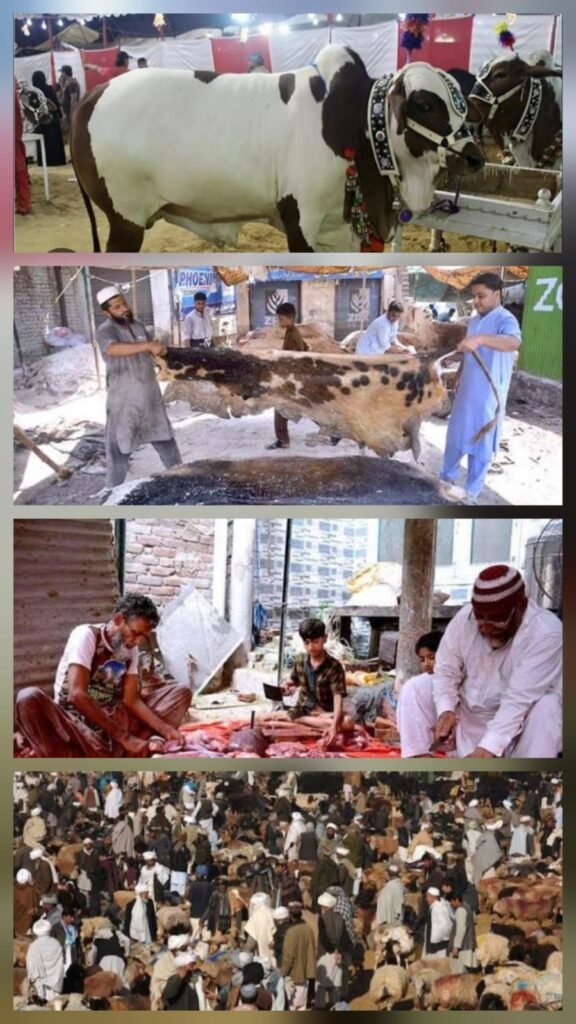
Eid-ul-Adha in Pakistan represents one of the largest annual economic events generating an estimated Rs600–800 billion in just a few days with activity spanning livestock trade, rural incomes and industrial supply chains.
This massive economic cycle unfolds largely outside formal systems, driven by millions of households fulfilling a religious obligation while simultaneously stimulating nationwide financial activity.
Scale of Economic Activity
Pakistan witnesses the sacrifice of approximately 7 million animals during Eid-ul-Adha, including cattle, goats, sheep and camels.
Key estimates suggest:
Total spending ranges between Rs600–750 billion
Around 80–85% of value comes from animal sales
The remaining share includes butchers, transporters and market services
This level of private spending is equivalent to nearly half of Pakistan’s annual development budget, occurring within just three days.
Informal Economy Dominance
A defining feature of Eid-ul-Adha is its cash-based and informal nature making it difficult to fully capture in official economic data.
Most transactions occur outside banking channels
Livestock markets operate without formal documentation
Millions of workers (butchers, traders, transporters) remain unregistered
Despite this, spikes in cash circulation during Eid confirm the scale of economic activity, reflecting a parallel economy that functions independently of state systems.
Rural Wealth Transfer Mechanism
Eid-ul-Adha acts as a powerful urban-to-rural wealth transfer system.
Around 90–95% of sacrificial animals are raised by rural households
Billions of rupees flow from cities to villages in a matter of days
Farmers receive a major portion of animal sale proceeds
This makes Eid one of the largest direct income injections into rural Pakistan, supporting livelihoods, debt repayments and household spending.
Supply Chain Impact
The economic chain of Eid-ul-Adha includes multiple sectors:
Livestock farmers and breeders
Traders and mandi (market) operators
Transport and logistics providers
Butchers and meat processors
Hide collectors and tanneries
Each step generates income, making Eid a multi-sector economic engine powered by decentralized participation.
Boost to Leather Industry
Eid-ul-Adha plays a crucial role in supporting Pakistan’s leather export sector.
Around 25–30% of annual hides come from sacrificial animals
These hides feed into the production of export goods
Pakistan’s leather exports reached approximately $800 million in recent years
This positions Eid as a key supplier event for an important industrial and export segment.
Food Distribution and Social Impact
Beyond economics, Eid-ul-Adha enables large-scale protein distribution across society.
Over 500,000 tonnes of meat distributed nationwide
Meat shared among family, community and the poor
Functions as an informal social welfare system
This redistribution occurs without state intervention, driven purely by religious and social norms.
Structural and Policy Insights
The scale of Eid-ul-Adha highlights deeper realities about Pakistan’s economy:
The informal sector is larger than officially measured
Economic activity often operates beyond taxation and regulation
Lack of data limits effective policymaking
Experts suggest improved tracking through:
Livestock and sacrifice census systems
Standardized municipal waste and hide data
Monetary analysis of cash circulation
Conclusion
Eid-ul-Adha is not only a religious festival but also a powerful economic phenomenon driving hundreds of billions of rupees in activity, sustaining rural livelihoods and supporting key industries.
It demonstrates how decentralized, faith-driven practices can generate large-scale economic impact, while also revealing the limitations of Pakistan’s formal economic measurement systems.
Keywords:
Eid ul Adha economic impact Pakistan
Bakra Eid economy 2026 Pakistan
livestock market Pakistan Eid
rural income Eid ul Adha
Pakistan informal economy cash flow
leather industry Pakistan hides Eid
urban to rural wealth transfer Pakistan
qurbani economic impact Pakistan
Pakistan GDP Eid ul Adha
cash circulation Eid Pakistan
Asian Burg | Pakistan / Economy
Send your feedback via email info@asianburg.com