




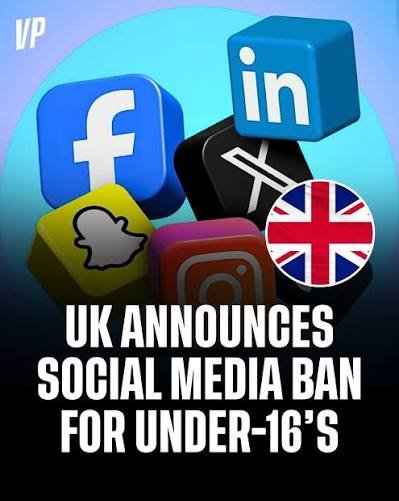
The United Kingdom’s decision to impose one of the toughest social media bans for under-16s marks a defining moment in the global debate over digital safety. Prime Minister Keir Starmer has framed the move as a bold step to protect children from online harm. However, the policy reflects both a genuine concern and a familiar risk oversimplifying a complex problem.
Under the proposed law, children under 16 will be barred from major platforms such as TikTok, Instagram, Facebook, YouTube, Snapchat and X. The restrictions go further than previous efforts seen in countries like Australia and Spain extending beyond social media to limit features such as livestreaming and interaction with strangers on gaming platforms.
At first glance, the logic is compelling. Social media platforms are often criticised for exposing children to harmful content, addictive algorithms and online predators. With rising concerns about mental health and digital well-being, governments are under pressure to act decisively.
But the effectiveness of such bans remains highly questionable. Evidence from Australia the first country to implement a similar restriction suggests that enforcement is far from straightforward. A significant number of children reportedly found ways to bypass the ban continuing to access platforms despite legal barriers.
This highlights a central flaw in the UK’s approach that technology evolves faster than regulation. Simply restricting access does not eliminate demand. Instead, it risks pushing young users toward less regulated and potentially more dangerous corners of the internet.
There is also the question of practicality. Enforcing age verification at scale raises serious privacy concerns, particularly if it requires users to submit identification across multiple platforms. Tech companies have already signalled resistance arguing that blanket bans could isolate teenagers from beneficial online communities and access to information.
Supporters of the policy, including children’s charities have welcomed the move as a necessary intervention. They argue that parents need clearer boundaries in navigating the digital world. Yet even these advocates acknowledge that a ban alone is not a “silver bullet.”
This is where the policy risks falling short. By focusing heavily on restriction, the government may be overlooking more sustainable solutions such as platform accountability, digital literacy education and safer design standards.
The broader trend is also worth noting. Countries across Europe and beyond are moving toward tighter regulation of children’s online activity. This signals a global shift toward what some might call a more paternalistic digital environment, where governments take a stronger role in shaping online behaviour.
However, regulation without adaptability can quickly become outdated. If the UK fails to build a flexible and enforceable framework, this ambitious policy could struggle to deliver meaningful results.
Ultimately, protecting children online is an urgent and legitimate goal. But it requires more than sweeping bans. It demands a balanced approach that combines regulation, education and technological innovation.
Otherwise, the UK’s landmark policy risks becoming less of a solution and more of a symbolic gesture in the ongoing battle to make the digital world safer for the next generation.
Keywords:
UK social media law children, Keir Starmer social media ban, child online safety UK, social media restrictions Europe, TikTok ban kids UK, online safety policy UK, digital regulation children, tech regulation UK
Asian Burg | Tech / Policy