



The most valuable metals on Earth may have spent billions of years hidden far below human reach and scientists now have stronger evidence that a tiny portion of this ancient treasure is slowly making its way back toward the surface.
A new study of volcanic rocks from Hawaii suggests that Earth’s molten core is not as sealed off from the rest of the planet as scientists once believed. Minute traces of material from the core appear to be reaching the mantle and eventually emerging through volcanic activity.
The finding is significant not because it promises a new source of easily mined gold. It does not. Rather, it challenges a fundamental assumption about how the planet’s deepest layers interact and offers a rare glimpse into processes taking place thousands of kilometres beneath our feet.
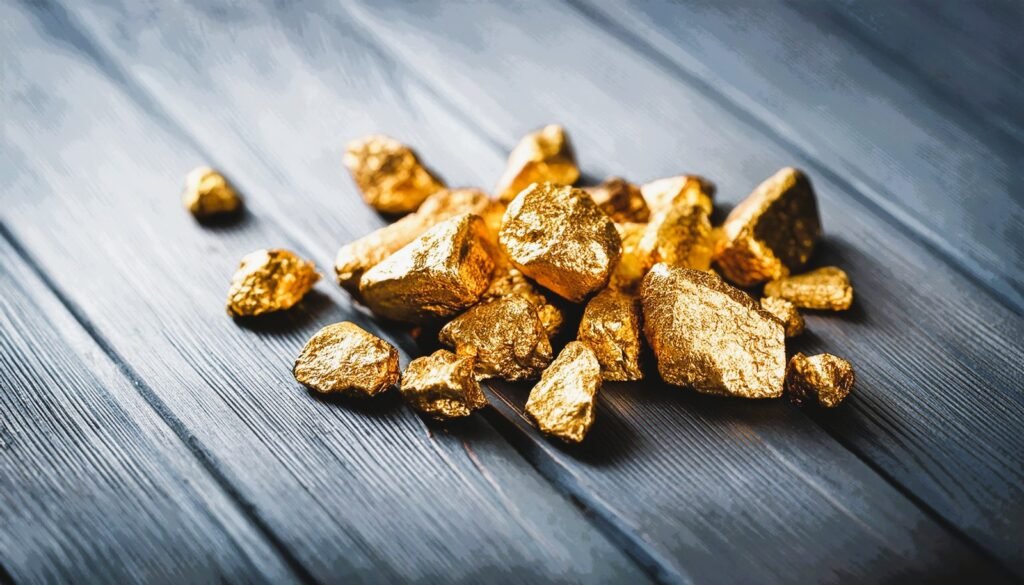
More than 99.95 per cent of Earth’s gold is believed to be concentrated in the core, along with other precious metals such as platinum. These elements became concentrated there during the planet’s formation roughly 4.5 billion years ago, when heavy materials sank toward the centre of the young Earth.
For decades, scientists have debated whether some of that material could eventually escape the core. The difficulty was finding evidence strong enough to distinguish core material from material already present in the mantle.
Researchers led by geochemist Nils Messling of the University of Göttingen approached the problem through an unlikely messenger: ordinary-looking basalt from Hawaii.
The team examined volcanic rocks produced by deep magma plumes associated with Hawaii’s hotspot. Instead of searching directly for gold, scientists focused on ruthenium, a rare platinum-group metal with a distinctive isotopic signature. Because ruthenium is strongly concentrated in the core and scarce in the mantle, it can act as a chemical fingerprint.
The results were striking. The researchers detected an isotope pattern that, according to their analysis, points to material originating from the period when Earth’s core was forming. Its presence in Hawaiian volcanic rocks suggests that at least some core-derived material has travelled upward through the mantle.
This where the discovery becomes bigger than gold.
The evidence suggests that the boundary separating Earth’s metallic core from its rocky mantle may not be an absolute barrier. Vast quantities of superheated mantle material can rise from near this boundary, eventually feeding volcanic islands and other geological features at the surface.
The process is extraordinarily slow. Researchers estimate that the journey can take hundreds of millions of years, perhaps between 500 million and one billion years. There is therefore no prospect of humanity suddenly discovering a new underground gold supply.
Indeed, the amount of core-derived precious metal reaching any individual location is tiny. The deepest human drilling has reached only about 12.3 kilometres into Earth insignificant compared with the nearly 2,900 kilometres separating the surface from the core.
Yet geological significance should not be measured by immediate economic value.
The discovery reinforces a broader lesson about the planet: Earth is a dynamic system in which materials can move, transform and reappear across immense stretches of time. What appears permanently locked away may, under the right conditions, become part of another geological cycle.
It also changes the way scientists can think about the history of Earth’s interior. Volcanic rocks are not simply products of eruptions. They can carry chemical evidence from places humanity can never directly visit.
That makes them geological archives of extraordinary importance.
There is an understandable temptation to focus on the headline that Earth’s core is “leaking gold”. But the more consequential story is that the planet’s deepest interior is communicating with its surface in ways scientists are only beginning to understand.
The finding may also encourage a more cautious view of natural resources. Gold has long been treated primarily as a commodity mined, traded and accumulated as a store of wealth. Yet its journey began long before human civilisation, through planetary processes operating on timescales almost impossible to comprehend.
Earth’s resources are therefore not simply deposits waiting to be extracted. They are products of a geological history that remains active.
The new evidence does not mean the planet possesses an unlimited supply of gold, nor does it justify predictions of a future mineral bonanza. The replenishment suggested by the study is minuscule on human timescales.
What it does provide is something more valuable to science: evidence that the boundary between Earth’s core and mantle is not as isolated as once assumed.
Humanity cannot drill to the source. We cannot see the core directly. But volcanic rocks can bring fragments of its story to the surface.
The real treasure is not the gold itself. It is the knowledge that Earth still has secrets moving beneath us slowly, invisibly and on a scale far beyond human time.
Keywords: Earth’s core leaking gold, gold in Earth’s core, core mantle interaction, Hawaii volcanoes, ruthenium isotope, Earth science, volcanic rocks, planetary geology, molten core, precious metals
Asian Burg / International