




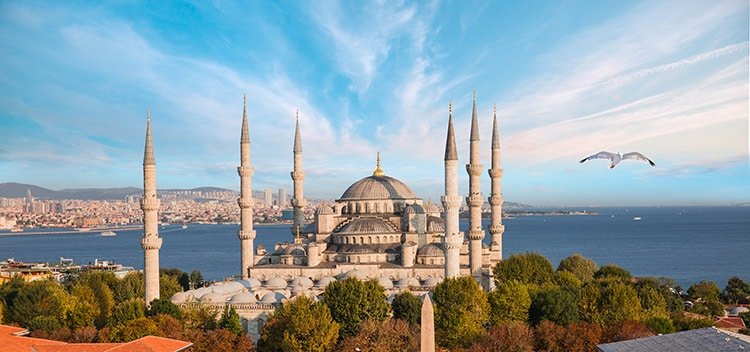
Istanbul’s skyline is defined by a remarkable blend of history, culture and architecture and among its most iconic landmarks stands the Sultan Ahmed Mosque, widely known as the Blue Mosque. Renowned for its striking domes, six towering minarets and richly decorated interior, the mosque represents one of the finest achievements of Ottoman architecture and continues to draw visitors from around the world.
Constructed between 1609 and 1616 during the reign of Sultan Ahmed I, the mosque was designed not only as a place of worship but as part of a broader social and economic complex. At the time, Istanbul, then known as Constantinople, served as the heart of the Ottoman Empire, which spanned three continents. The mosque complex included a madrasa, hospital, soup kitchen, marketplace and other public facilities, reflecting the Ottoman vision of integrating religion with community life and social welfare.
Positioned on the historic peninsula at the meeting point of the Bosphorus Strait, the Golden Horn and the Sea of Marmara, the mosque occupies one of the most historically significant locations in the city. The surrounding area, now known as Sultanahmet has long been the centre of imperial power and cultural development, featuring landmarks such as Topkapi Palace and the remains of the ancient Hippodrome of Constantinople.
The architectural ambition behind the Blue Mosque was closely tied to Sultan Ahmed I’s desire to establish his legacy. Ascending the throne at a young age, he sought to rival the grandeur of the nearby Hagia Sophia, a Byzantine masterpiece that had dominated the city’s skyline for centuries. The result was a structure that blended traditional Islamic design with Byzantine influences, particularly in its cascading domes and expansive central prayer hall.
One of the most distinctive and controversial features of the mosque is its six minarets. At the time of its construction, this number matched that of the Masjid al-Haram in Mecca, the holiest site in Islam leading to criticism and debate. According to historical accounts, the controversy was resolved by adding an additional minaret to the mosque in Mecca restoring its unique status.
Inside, the mosque earns its popular name from the more than 20,000 handcrafted Iznik tiles that adorn its walls and ceilings. These tiles, dominated by shades of blue and intricate floral patterns, create a serene and luminous atmosphere. Natural light enters through hundreds of windows enhancing the visual impact of the interior and reinforcing the symbolic connection between the space and the heavens.
The mosque remains an active place of worship, hosting daily prayers while also welcoming visitors between prayer times. This dual role reflects its enduring significance as both a religious site and a cultural landmark. Tourists from around the world continue to visit, drawn by its architectural beauty and historical importance.
Beyond its physical structure, the mosque is deeply connected to the story of Sultan Ahmed I. His reign came at a time when the Ottoman Empire was facing political and military challenges and the construction of such a grand monument drew criticism due to the absence of major military victories that traditionally funded imperial projects. Nevertheless, the mosque was designed with long-term sustainability in mind, supported by revenues generated from surrounding commercial spaces.
Sultan Ahmed I is also remembered for breaking with the longstanding Ottoman practice of royal fratricide, choosing not to execute his younger brother upon ascending the throne. This decision marked a significant shift in imperial policy, though it introduced new challenges for governance in later generations.
Over the centuries, the Blue Mosque has remained a symbol of Istanbul’s historical and cultural identity. Despite political changes and the eventual decline of the Ottoman Empire, the structure has endured as a testament to artistic vision and architectural innovation. Its recent restoration has ensured that it continues to serve both worshippers and visitors preserving its legacy for future generations.
Today, the Sultan Ahmed Mosque stands not only as a masterpiece of design but also as a reflection of the ambitions, challenges and transformations of the Ottoman era. Its presence on Istanbul’s skyline continues to represent a connection between past and present offering insight into the enduring influence of history on the modern world.
Keywords:
Blue Mosque Istanbul, Sultan Ahmed Mosque history, Ottoman architecture Istanbul, Istanbul landmarks, Hagia Sophia comparison, six minarets controversy, Ottoman Empire history, Islamic architecture design, Istanbul tourist attractions, Sultan Ahmed I legacy, Iznik tiles Blue Mosque, historical sites Istanbul, mosque architecture features
Asian Burg \ Travel / History
Send your feedback via email info@asianburg.com