




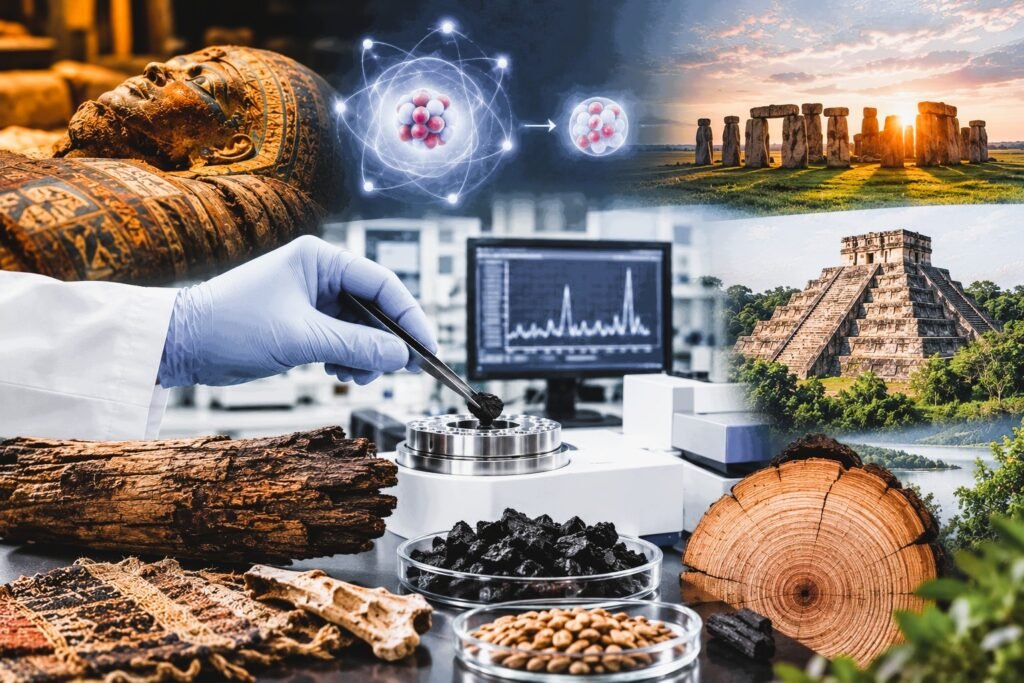
How do scientists estimate the age of an Egyptian mummy, investigate the history of the Maya civilisation or establish when ancient wooden structures were built? One of the most important tools they use is radiocarbon dating, a scientific technique that measures the amount of radioactive carbon remaining in once-living material.
Developed in the mid-20th century, the method transformed archaeology by allowing researchers to estimate the age of organic remains rather than relying solely on historical records, artistic styles or comparisons with other objects. It also became valuable to researchers studying ancient climates, changing ecosystems and the long-term effects of human activity on the planet.
The Discovery Behind Carbon-14 Dating
The story began with the discovery of carbon-14, a radioactive form of carbon produced artificially in 1940 by scientists Martin Kamen and Sam Ruben at the University of California, Berkeley.
American chemist Willard Frank Libby later recognised that carbon-14 could provide a way to estimate the age of ancient organic materials. During the 1940s, he developed the principles of radiocarbon dating and helped demonstrate that naturally occurring carbon-14 could be measured in living matter and its remains.
One of the challenges was detecting extremely small quantities of the isotope. To test his ideas, Libby and his colleagues examined methane obtained from sewage-treatment facilities in Baltimore, Maryland. The material provided evidence of naturally occurring radiocarbon and helped establish the feasibility of the method.
The work led to a major breakthrough in scientific dating. In 1960, Libby received the Nobel Prize in Chemistry for developing a method that would reshape archaeology, geology and other fields concerned with the age of the natural and human past.
How Does Carbon-14 Dating Work?
Carbon is present throughout the natural world. In the upper atmosphere, cosmic rays help trigger reactions that produce carbon-14. The isotope becomes part of atmospheric carbon dioxide, which plants absorb during photosynthesis.
Animals obtain carbon by eating plants or other animals, while humans acquire it through food. As a result, living organisms continually exchange carbon with their surroundings and maintain a supply of carbon-14.
The process changes after an organism dies. It stops taking in new carbon and the carbon-14 already present in its tissues gradually decays into nitrogen-14 at a predictable rate.
Carbon-14 has a half-life of approximately 5,730 years. This means that, over that period, about half of the original carbon-14 in a closed sample will decay. After another 5,730 years, approximately half of what remained will have decayed as well.
By measuring the carbon-14 left in a sample and comparing it with expected levels, scientists can estimate how long ago the organism died. The result is not simply a reading from a clock: researchers must also account for changes in atmospheric carbon-14 over time and calibrate their measurements against independently dated records, including tree rings.
What Can Scientists Date?
Radiocarbon dating is useful for materials that once formed part of living organisms. These include wood, charcoal, seeds, bones, plant fibres, textiles and some types of ancient paper.
The technique has helped researchers investigate Egyptian mummies, date wooden objects recovered from archaeological sites and establish chronologies for prehistoric settlements. It can also help determine when timber was cut, when a fire burned or when particular plant and animal remains were deposited.
However, the method does not directly date every ancient object. A stone monument, for example, cannot ordinarily be dated using carbon-14 simply because it is old. Scientists may instead date charcoal, wood or other organic material securely associated with its construction, provided that the material genuinely relates to the event being investigated.
This distinction matters because an old piece of wood could have been reused long after the tree died. The age of the sample and the age of the structure containing it are not always identical.
Radiocarbon dating is generally most useful for organic material up to around 50,000 years old, although the practical limit depends on the sample, preservation and measurement technique. Beyond that range, so little carbon-14 remains that reliable measurements become increasingly difficult. Other dating methods are needed for much older geological material.
From Archaeology to Environmental History
The significance of radiocarbon dating extends beyond establishing the age of individual artefacts. It allows researchers to connect evidence from different periods and reconstruct how human societies and natural environments changed over time.
By dating charcoal, seeds, wood and other preserved material, scientists can investigate ancient vegetation, changes in land use, past fires and the development of human settlements. When combined with evidence from ice cores, tree rings, sediments and other scientific records, radiocarbon measurements can contribute to broader reconstructions of environmental history.
These findings also help researchers understand the relationship between human activity and the planet’s changing systems. Archaeological and environmental evidence can reveal how agriculture spread, how landscapes were transformed and how communities responded to shifts in climate and available resources.
Radiocarbon dating does not, by itself, explain modern climate change or establish every cause of an environmental shift. Its strength lies in helping scientists build reliable timelines that can be compared with other evidence to test explanations about the past.
Why This Scientific Breakthrough Still Matters
Before radiocarbon dating, researchers often depended on historical documents, artefact comparisons and the order in which objects appeared in archaeological layers. Those approaches remain important but carbon-14 offered a new way to test timelines using measurable physical evidence.
The method has continued to improve since Libby’s pioneering work. More sensitive instruments, better sample preparation and improved calibration have helped scientists obtain useful results from smaller samples and refine estimates of age.
Yet every measurement still requires careful interpretation. Contamination, sample selection and the context in which material was found can influence the conclusions. Scientists therefore combine radiocarbon results with archaeological knowledge and other dating techniques whenever possible.
The achievement is remarkable because an invisible process inside atoms can help illuminate events that occurred thousands of years ago. From ancient human remains to traces of long-vanished ecosystems, carbon-14 dating provides a means of testing our understanding of history against evidence preserved in the physical world.
Its enduring value lies not simply in telling us how old something is but in helping us reconstruct the stories behind it and better understand the world we have inherited.
Munir Hussain Chopra

About Author:
Mr. Hussain is a mid-career civil servant with a keen interest in public policy, governance, socioeconomic issues and institutional reform. His writings focus on analyzing contemporary challenges through the lens of policy, administration and social impact aiming to encourage informed public discourse.
Keywords: carbon-14 dating, radiocarbon dating, ancient artefacts, archaeological dating, Willard Libby, Egyptian mummies, Stonehenge, Maya civilisation, scientific discoveries, climate history
Asian Burg / knowledge Hub