



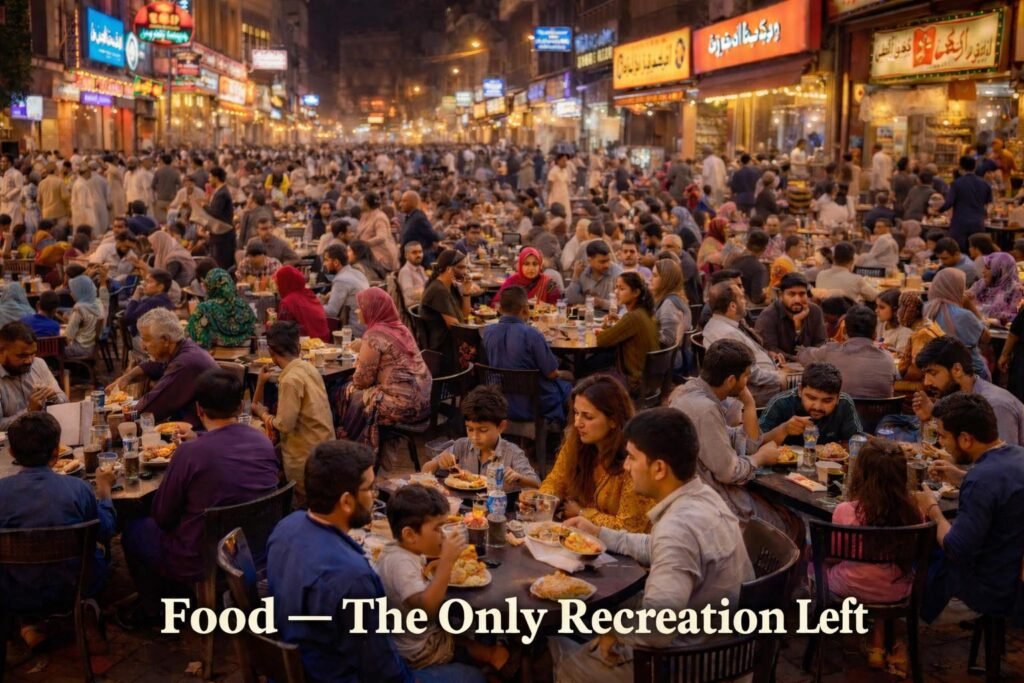
In contemporary Pakistan, recreation has been reduced to food consumption. As public parks shrink, libraries vanish, cinemas close and sports facilities remain inaccessible or unsafe. On the other hand, food has emerged as the most reliable and socially neutral form of leisure. Eating out now substitutes for nearly every form of collective relaxation,family outings, youth gatherings, professional meetings and even emotional release. This is not a cultural accident rather it is the predictable outcome of decades of neglect in public space planning, cultural investment and inclusive urban policy.
In more balanced societies, recreation is diverse and accessible. Parks, libraries, museums, sports facilities, cultural festivals, theatres and public spaces offer citizens multiple ways to unwind, socialise and express themselves. In Pakistan, most of these avenues are either underdeveloped, inaccessible, unsafe or socially marginalised. As a result, food has filled the vacuum. It requires minimal infrastructure, carries low cultural resistance and is easily commercialised.
The reduction of recreation to food-centred socialising carries significant public-health costs that remain largely unacknowledged. When leisure is dominated by eating out rather than physical, cultural or outdoor activities then sedentary behaviour becomes normalised across age groups. This contributes to rising rates of obesity, diabetes, cardiovascular disease and digestive disorders. Equally important are the mental-health implications: in the absence of stress-relieving outlets such as sports, green spaces and creative engagement, food becomes a coping mechanism for anxiety, social isolation and urban fatigue. What appears to be harmless social dining thus masks a broader health regression where preventable lifestyle diseases proliferate not due to individual failure but because healthier recreational choices are structurally unavailable.
This imbalance also reflects policy neglect. Urban planning prioritises commercial outlets over public spaces. Cultural funding is minimal. Sports and arts are treated as luxuries rather than necessities. When the state abdicates responsibility for collective recreation then market steps in—with food as its easiest product.
The way forward is not to disparage food culture but to rebalance public life. Cities must invest in parks, walkable spaces, libraries, community sports and affordable cultural events. Schools and local governments should treat arts, music and physical activity as integral to social well-being. Public festivals,secular and inclusive, must be encouraged to restore shared joy beyond food consumption only.