




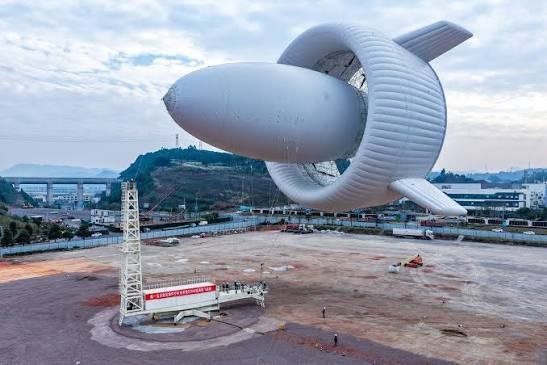
China is pushing the boundaries of renewable energy with a new generation of airborne wind turbines floating systems designed to capture stronger and more consistent winds at high altitudes. This innovation could redefine how wind energy is generated, especially in areas where traditional turbines are not practical.
The project, known as Stratospheric Airborne Wind Energy Systems (SAWES) is being developed through collaboration between research institutions and technology companies in China. These turbines are not mounted on towers like conventional windmills. Instead, they are helium-filled structures that float thousands of feet above the ground, connected by cables that transmit electricity back to Earth.
One of the most advanced prototypes, the SAWES S2000, has already demonstrated its capabilities. During testing, it operated at an altitude of around 2,000 meters and successfully generated electricity that was fed into the grid. With a capacity of up to 3 megawatts, the system represents a major step forward in airborne energy technology.
The key advantage of these systems lies in altitude. Winds at higher elevations are generally stronger and more stable than those near the surface. By accessing these conditions, airborne turbines can potentially produce more consistent energy compared to traditional wind farms.
Another benefit is environmental impact. Unlike ground-based turbines, airborne systems require significantly less material and do not need large foundations or extensive land use. This makes them especially suitable for environmentally sensitive areas or regions with limited space, such as islands or remote locations.
In addition, the systems are designed to be portable. They can be transported in a deflated state and deployed quickly, making them useful for emergency power supply or off-grid energy needs. This flexibility could prove valuable in disaster zones or developing regions with limited infrastructure.
However, the technology is still in its early stages. Experts note that there are challenges related to aviation regulations, safety and long-term performance. Operating large airborne structures requires strict compliance with airspace rules and more independent testing is needed to verify efficiency and durability.
There are also technical questions about how wind behaves at extreme heights and how effectively energy can be transmitted through long tether cables. While early results are promising, large-scale commercial deployment will depend on further research and validation.
Despite these challenges, airborne wind energy represents a promising direction for the future of renewable power. As the world works toward reducing carbon emissions and achieving net-zero targets, innovations like SAWES could play a crucial role in expanding clean energy capacity.
In the broader context of global energy demand, wind power must grow rapidly to meet sustainability goals. China’s leadership in this field, combined with its willingness to experiment with new technologies, positions it at the forefront of the next wave of renewable energy innovation.
If successfully scaled, airborne wind turbines could complement existing energy systems and help bring clean, reliable power to places where it was previously difficult to generate marking a significant step forward in the transition to a more sustainable future.
Keywords:
China wind energy innovation, airborne wind energy systems, SAWES turbines explained, renewable energy technology, high altitude wind power, future of clean energy
Asian Burg \ Climate / Clean Energy