




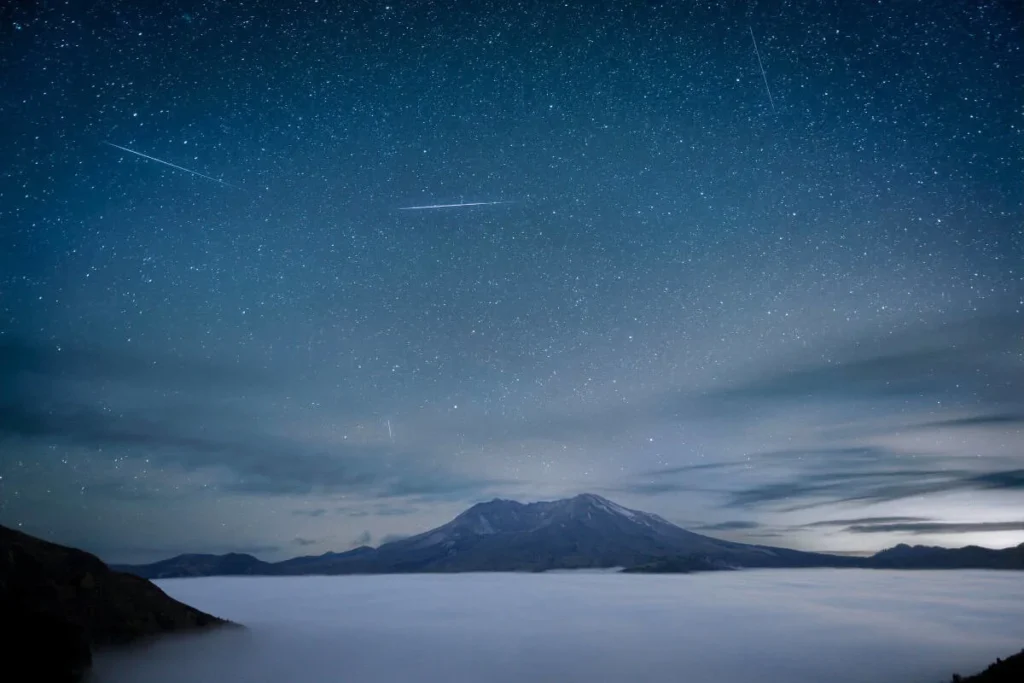
Skywatchers have a rare opportunity this week as two annual meteor showers reach their peak at nearly the same time creating a brief window of increased celestial activity. The Alpha Capricornids and Southern Delta Aquariids are expected to hit their highest activity levels simultaneously, offering a combined display of streaking meteors across the night sky.
This overlap occurs when Earth moves through dense streams of cosmic debris left behind by comets. During this period, particles enter the atmosphere at high speeds, burning up and creating the bright trails commonly known as shooting stars. While both meteor showers occur every year, their peak alignment is a less frequent event that draws attention from astronomy enthusiasts.
Despite the excitement, viewing conditions this year may not be ideal. A bright full moon is expected to dominate the night sky around the same time, significantly reducing visibility. The intense moonlight can wash out fainter meteors, making it more difficult for observers to spot the full extent of the activity. Experts note that such interference from lunar brightness occurs periodically and can limit what would otherwise be a more dramatic display.
Even with these challenges, some meteors should still be visible, particularly the brighter ones associated with the Alpha Capricornids. This shower is known for producing slower but more luminous meteors, which can stand out even under less favourable conditions. Meanwhile, the Southern Delta Aquariids typically generate faster-moving meteors, though they tend to be dimmer and harder to detect when the sky is illuminated by moonlight.
Geography also plays a role in the viewing experience. Observers in the Southern Hemisphere are likely to have a slight advantage, as the point from which the meteors appear to originate sits higher in their sky. This positioning increases the chances of spotting more activity compared to viewers in northern regions.
For those hoping to catch a glimpse, careful positioning can improve visibility. Finding a location away from artificial light sources, choosing higher ground and ensuring the moon is behind the observer can help reduce glare and enhance night vision. Allowing time for eyes to adjust to the darkness is also essential for spotting faint streaks across the sky.
Beyond their visual appeal, meteor showers serve an important scientific purpose. Observations of these events help researchers better understand the distribution of particles in space and track how Earth interacts with debris fields throughout its orbit. This information contributes to improving models of the near-Earth environment and plays a role in protecting satellites and future space missions.
While this week’s dual meteor activity may be partially obscured, it still marks an important moment in the annual astronomical calendar. Another major highlight, the Perseid meteor shower, is expected to peak later in August and is widely regarded as one of the most spectacular displays of the year.
For now, even a few visible meteors cutting through the glow of the moon serve as a reminder of the dynamic nature of space just beyond Earth’s atmosphere.
Keywords
meteor shower 2026, Alpha Capricornids peak, Delta Aquariids peak, Perseid meteor shower 2026, how to see meteor shower, night sky events July 2026, NASA meteor viewing tips, astronomy events 2026, meteor visibility full moon, stargazing guide
Asian Burg/ Science / Space